How I Won Beer Can Races With the Slowest Boat
Practical lessons from 10 years of club racing: sail less distance, stay in clear air, and use local knowledge.
I am writing this to help you win club races. I raced them for about 10 years. I also raced one design but that is a different story. In the beer can races I had the slowest boat but that didn't stop me from occasionally crossing the line first and always crossing ahead of all but the fastest boats. The slowest boat can still win if it sails the shortest distance.
Along the way I improved and want to share what I learned. My style is not for the professional sailor and isn't what you have read about in books on racing. In fact it is quite different in many ways, but it worked and I think it is worth sharing.
My handicap is 153. The other boats in the class had handicaps between 75 and 147. In other words, I had the slowest boat. But on a typical race, the boats with handicaps in the 70's would usually have elapsed times less than mine and the boats with handicaps 99 to 147 would be behind me. I won on corrected time in about 2/3 of the races I entered.
You may ask how that is possible if I had the slowest boat, and the secret is I didn't sail as far. I did not race like the other boats. I did not start like them, I did not round marks like them, and I did not sail like them. I was also much more cautious. My boat is wood and it is my baby. I don't want to hurt her. It is not really a baby because if it was human, it would qualify for Social Security.
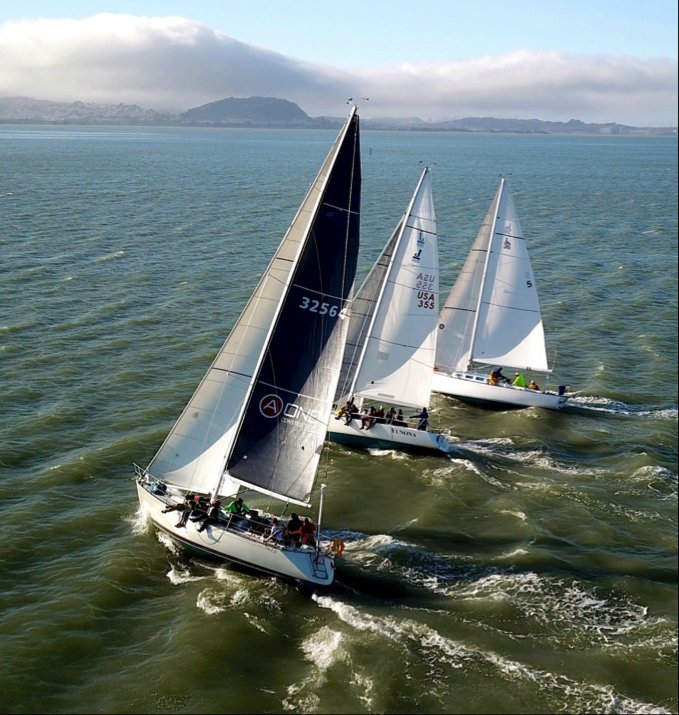
Photo of the two boats with handicaps in the 70s and Papoose approaching the windward mark.
In this article
1. Know the Course
The obvious part is knowing where the marks are. Put them in your GPS. You can probably find the marks here: USCG Light List and Waypoint Tools. From there you can create a GPX file and upload it to your chartplotter or GPS.
Also know what the course is and which way the marks are rounded. But that is the easy part. The important part is something called local knowledge. Acquire it.
Know the current. Know the wind patterns. Know where the shallow areas are and how they affect both wind and current.
I learned this lesson the hard way in a one design race. We started well and were far ahead of the boat I needed to beat after rounding the second mark. I used the published tide chart and sailed toward deeper water where the current should have been weaker.
What I did not know was that closer to shore the current had already turned and was favorable. My competitor had that local knowledge. He sailed along the shoreline and went past me like I was standing still. Well, not exactly standing still, but you get the idea.
After the race I said to him that I probably should have covered him. His reply was something I will always remember: "It is hard to cover when you are so far ahead."
After that race I took my crew to the Bay Model to attend a lecture on currents in San Francisco Bay. That eventually led me to develop the current model for San Francisco Bay on this site.
Local knowledge also applies to wind. Where we raced our beer can series, the last leg from mark "6" to the finish was over three nautical miles. Conventional wisdom says to sail the middle of the course and play the periodic shifts. But in ten years of racing we saw those periodic shifts maybe once.
Instead, there was usually a persistent shift of about ten degrees. There was also more wind as you moved toward the layline. So instead of sailing the middle, we would tack about ten degrees before the layline, get into the heavier air, and sail the rest of the leg on one tack to the finish.
Another way to acquire local knowledge is to watch the sailors who have been racing there for years. In our fleet some boats had been racing the same course for decades. They knew what worked, and in fact the strategy some boats adopted was very simple: "Follow Papoose."
2. Know Your Boat
Do you know which sails to use in which wind conditions? Do you know when there is too much wind for your boat or your crew?
Our club had limits: wind over 30 knots or gusts over 35 and the race was cancelled. Some clubs also have temperature limits. It depends on where you sail. But regardless of the rules, you should know when conditions are beyond what your boat and crew can safely handle.
Boat Handling
Do you know your target boat speed when sailing to weather? If not, read this target boat speed article. It is probably the most important thing you need to know when sailing upwind.
Do you know how much your boat should heel? On my boat the correct heel angle is about 25 degrees. Any more than that and we start to bubble the main to spill wind and control the heel. Keep the traveler low, flatten the sail, and ease the sheet as needed to keep the boat under control.
Is your boat set up to point well? Do you have an inside track and sails that can sheet inside the rigging? Do you know how to point high? See how to point higher. Pointing higher is key to sailing a shorter distance.
Sails
Are your sails in good shape or are they 40 years old? Getting new sails can feel like getting a new boat. You don't need new sails for club racing but you don't want old ones either.
I started sailing with sails that were about 40 years old. About 30 years ago I bought a new main and a #3 jib from North. Later I replaced my larger jibs. The North main never really fit the boat quite right, so I bought a new main, a 130, and a 155 from Quantum. My racing improved noticeably when I finally had a decent set of sails.
I never replaced those jibs, but I did add sails to fill specific needs. For example, the 155 worked well up to about 20 knots, but I wanted something lighter for very light air, so I bought a free flying light 155 that is really only good up to about 10 knots.
I also changed my #3 from a high-cut North jib to a low-cut, inboard-sheeted 90 racing jib. I loved that sail. I replaced the main about every ten years. My sailmaker gave me a simple rule: "Replace the sail when you wish it still looked like it did when it was new".
Spinnakers
Spinnakers are another place where knowing your boat matters a lot. Do you know how to fly one? Do you practice it regularly? If not, you may not benefit from using one at all.
I bought a symmetric spinnaker and later an asymmetric. The asymmetric was not about speed. It was because I rarely had enough crew to handle the symmetric reliably and besides, we were getting old. My boat was actually faster downwind using a light, blown-out 40-year-old 150 jib on a long whisker pole than it was with an asymmetric but it was fun.
I once sailed three minutes past the mark while my pickup crew tried to get the spinnaker down. We had planned for two minutes to get it down. The total delay was five minutes. We lost that race by fifteen seconds.
I learned how spinnaker work should be done when I sailed with Tim on his boat. We never lost a race while I sailed with them. Not because of me, I assure you. They practiced every Wednesday. They also had a system. The spinnaker always came down as they rounded the mark. They always rounded and set the jib on the same tack because that is what they practiced. If the other tack was favored, they would tack after the spinnaker was down and the boat was settled.
That kind of consistency makes things reliable. I have seen far more races lost by sailing past the mark or wrapping the spinnaker than races won because of a spinnaker. Except for Tim. He would just smoke everyone.
I actually have a beautiful almost new symmetric spinnaker that I almost never use. I also have an asymmetric spinnaker that I bought not because I needed more speed, but because I wanted one.
After a few episodes of "flossing the keel" with the spinnaker sheet, I realized something useful. You do not actually have to jibe an asymmetric spinnaker. You can fly it wing on wing. On a boat like mine that is actually faster than sailing with the spinnaker on the same side as the main.
My decision not to jibe the spinnaker was not about speed. It was about knowing my crew could not reliably pull it off. That is what I mean by knowing your boat. Know your boat as it is actually sailed, by the crew you actually have.
It is a Learning Process
Like local knowledge, you can learn from other sailors. If you race on Tuesday nights, volunteer to crew on Friday nights at another club. Ask the top sailors in your class what they do. Most sailors are happy to help if you ask.
And one more thing: know the rules. At a minimum, read Racing Rules of Sailing, Part 2. And carry a protest flag. If another boat hits you, it is better to establish fault in a protest room than in a court room.
Ask me how I know.
(video of Papoose being dismasted)
3. The Start
Starting is easy. Just cross the favored end of the line on starboard tack at the gun with clear air.
Of course every other boat in the race wants to do exactly the same thing, and only one boat can do it. All the rest will be sitting there in dirty air trying not to hit each other.
There are two parts to starting well. First is understanding which end of the line is favored. The second is deciding how you want to approach the start.
Which End Is Favored?
If the starting line is exactly perpendicular to the wind and you must tack to reach the first mark, then neither end of the line is favored. In fact that is usually the goal of the race committee when they set the line.
Some sailors think the favored end is simply the end closest to the first mark. That is only true if you can reach the mark without tacking. In that case the layline to the mark crosses the starting line, and starting near that crossing point is advantageous.
Current can change everything.
In the race I mentioned earlier where I lost despite being far ahead at the second mark, the starting line was parallel to the wind but there was a four knot current. In San Francisco Bay most boats normally start at the windward end of the line. On that day, because of the current, the other end was favored. We recognized that and started there, which helped put us ahead early.
In our club racing the starting line was usually well set and the effects of line orientation were small. Trying to determine the favored end often did not make much difference.
Why We Started at the Pin
There were three reasons we usually started at the pin end of the line. First, very few other boats started there. That meant we immediately achieved one of our main goals: clear air. Second, there was often more wind on that side of the course. That was local knowledge. Third, the wind direction tended to shift enough that trying to determine the favored end was often a fool's errand. So we simply started at the pin end almost every race.
Getting There at the Gun
Once you decide where you want to start, the next question is how to cross the line at the right time.
I used my StartLine program for this, although there are many other tools and methods that work just as well.
The basic idea is simple. First "ping" both ends of the starting line with your GPS so you know exactly where the line is. Then determine how long it takes your boat to sail down the line and cross it from a known distance away.
You start by sailing parallel to the line at a known cross-track error distance. Turn toward the line, cross it, and note the time it took. Now you know how long it takes your boat to reach the line from that position. From there you can sail away from the line, allow for the time needed to turn, and then turn back toward the line so you arrive at your chosen starting point with only a few seconds remaining.
If you are early, find a way to burn time. If you are late, head more directly toward the line instead of sailing parallel to it. And if worst comes to worst and you end up early, just circle the pin and start on port. I won the last race of the season doing exactly that.
Like everything else, it takes some practice.
Avoiding the Crowd
At our club most boats simply sailed along the line and crossed at the gun.
If you wanted to do the textbook start on starboard tack at the committee boat, you would have to cross that entire line of boats. You might technically have right of way, but asserting that right of way would almost certainly lead to shouting, protests, or worse. It was not a game I chose to play.
Starting at the pin end gave us clear air, room to maneuver, and a clean start. For our racing, that was far more valuable than fighting for the perfect start at the committee boat.
4. Sailing the Course
There are three parts to sailing the course: sailing upwind, rounding the mark, and sailing downwind.
Sailing Upwind
When sailing upwind I sail to a target speed. Everyone knows that it is best to sail at the best angle to the wind. Maybe you judge that by the masthead fly lining up at 30 degrees. Maybe to an instrument showing TWA of 45 degrees. What is important is to sail to something that is sensitive and responsive to changes in wind direction. That allows you to sail a consistent direction with the minimum of course changes due to noise in the instruments.
Of all ways to measure what direction you are sailing relative to the wind, the most sensitive is boat speed. Sail too high and boat speed falls off fast. Sail too low and it speeds up fast. It is both faster responding and more sensitive than any other instrument.
You also need to trim the sails correctly so make sure sails are trimmed for the condition. Tight and flat for high winds, a bit more fullness for light air. In heavy air and chop, give the sail some fullness but keep it in tight using an inhauler. That gives you the power to recover from being hit by a wave.
Get a tiller extension and sit where you can see the jib telltails. In heavy air, that telltail you are looking at should be straight up. In light air, straight back. If one side starts to flutter, move the tiller toward it.
Basically there is a target speed but also a proper trim. You can use instruments or masthead flys to make sure things are correctly set up but once you get that and the target speed is correct, sail to the tell tail and monitor the speed, keeping it at target. It is a balancing act. If you are at target but the wind angle is obviously wrong, you are not trimmed so figure out what is off and fix it.
The other important thing is to keep sailing the same relative angle to the wind. This keeps you sailing straight. And sailing straight and at your target speed is how you sail less distance. And sailing less distance with my slower boat is how I finished ahead of most of the other boats in the fleet even though they were faster.
A few years ago, our fleet used RaceQs largely because the guy who developed it was friends with one of our fleet's boats and he would crew on that boat. After one of the races, he told me he could tell from my track that I was going to win because my track was so much straighter than the other boats. It was that app that informed me that I was in fact slower than the other boats but that they sailed longer distances. That was a very enlightening moment and explained why my old boat was winning so much. Prior to that I really didn't understand how it was possible for me to finish ahead of larger boats.
A bit on target speed before I move on. If you have new sails, a clean hull, and everything up to regatta standards, you can find target speeds online for many boats. If you have sails from 5 years ago or longer or have an old boat like mine, you can find your target speed by going out and sailing using the method presented in the article on finding target boat speed referenced above. You only need your masthead fly and something to measure the wind speed. The tools on these pages will do averaging and curve fitting and help you average the readings to find the optimum.
While you are sailing to the jib tell tails and keeping the boat at target speed, the mainsheet trimmer is keeping the boat under control. On my boat that means not heeling more than 25 degrees. The main is eased to spill wind and brought in to centerline in light wind. The mainsheet is never cleated, it is constantly adjusted to the wind. On some boats, this is done with the traveler but on Papoose, the traveler is high in light air and low in heavy air.
IMHO, it is more important to sail to your target speed than to have that speed be exactly optimum. Sailing to a target speed helps you go straight and you will be pointing high enough that you will sail less distance and that is the goal.
Once you buy into this, you will no longer be impressed when you hand the till to an old pro and he reports he was able to get an additional half a knot out of the boat. You will realize he just made it take longer to finish the race because he took you on a longer path.
Rounding the Mark
Most important thing is to round in the correct direction. That aside, be sure to watch the mark relative to something on the opposite shore as you approach so you can see where the current is taking you. If you don't have current, lucky you!
The other thing to think about is where you want to be after you round the mark. Do you need to start your approach a fair distance from the mark so that you can round and come out close to the mark and gain a windward clear air position? If you almost kiss the mark on your approach, you will be far away from it on the other side.
It is such a thrill to come into a mark with another boat, approach far away, and end up to weather of the other boat and in a favorable position. This was very important for my boat because I out pointed most everyone and if I came out on the leeward side, I would be stuck.
One rule I had, taught to me by Tim, was don't approach the mark between two other boats. Just fall back and go outside them. This will also allow you to round and come out to windward of them. It avoids messy situations and your goal is to finish first and remember that to finish first, first you have to finish.
If you are coming to a mark with a spinnaker, know how long it takes your crew to take it down worst case. Know a time or distance to the mark and start your takedown at that point. If you practice and are as good as Tim was, just start the takedown as you round.
I remember coming into a mark on Tim's boat side by side with another boat. I guess they didn't want to take their spinnaker down before we did and they ended up rounding, getting forced up, and wrapping their spinnaker around the forestay. Know your boat.
Sailing Downwind
If you practice with your crew every week or at least enough to get good at it, have a way you take the spinnaker down and stick to it.
If you want to go just as quick without all the risk of screwing up the set or the douse, use your oldest and lightest large jib and fly it off a spinnaker halyard without clipping it to the forestay. If you really want to go fast, pole it out. Super fast, use a legal limit whisker pole like I did. I am sure we were faster with our jib from the 60's on our 22 foot whisker pole than we were with our spinnakers especially given we didn't practice more than once or twice a season. This tip was given to me by Kame Richards (google him).
Now, if you have a sport boat and go 20 knots downwind, I have nothing for you. But if you have a displacement boat the advice I can give is sail to the mark. But take into account how the wind will shift (local knowledge). Plan your route so you don't have to jibe. Be conservative. And allow enough time to take the sail down and get your jib up.
If you are flying an asymmetric, don't jibe it. Plan your first set accordingly. You might have to sail off your desired course until you get to a point where dead downwind is the desired course and then jibe the main and sail wing on wing. The issue is, of course, you can only sail maybe 140 to the wind with an asymmetric. Maybe your course is 160. So sail 140 until the heading to the mark is 180 and then jibe.
But Local Knowledge Trumps All
On the course I raced on, we made one tack at the layline about 3 miles from the finish line. On most courses it is best to sail the middle of the course but on ours there is more wind toward shore and often very little wind near the finish.
On more than one occasion I would coast across the finish line and wave to a much faster boat sitting becalmed needing to make one more tack to cross the line.
If we overstayed the layline, we gained some of that back by sailing a faster point of sail. If we tacked before the layline, we would either be slow because of pinching or be forced to tack near the finish and risk stopping the boat.
5. Tools
I spent a lot of money on a complete set of instrumentation. I wrote calibration software and built a RaceBox using an IoT Linux processor that worked with my StartLine software. In hindsight, I think you can do just as well with a good knotmeter, a masthead fly, and a handheld wind meter.
GPS and Waypoints
But to get around the course effectively, you do need a GPS. GPS units have changed a lot since I last bought one. Some are now designed specifically for sailing. I found two Garmin models that look interesting: a newer one (this Garmin GPS model) and a less expensive older version (older version).
For what I am suggesting, you want a unit that provides clear numerical data, not just a chart display. A phone might work, but they can be hard to read in sunlight and I am not sure what apps are best today. I used iRegatta years ago and even helped develop their starting algorithm before writing my own app. My app, StartLine, is no longer supported, so I can't recommend it.
Regardless of what system you use, enter all your course marks as waypoints. You can ping the marks directly or use USCG Light List and Waypoint Tools to load government marks. We would usually ping the windward mark on the way to the start and use published positions for the rest.
Using GPS on the Course
A useful function on many GPS units is the TURN angle, which tells you how much you need to change course to reach the waypoint. In the simplest case, you would tack when the TURN angle reaches 90 degrees. That is a bit too simple, but it works as a starting point. With experience, you can refine it. On our course there was a persistent 10 degree shift, so we would tack at about 80 degrees instead of 90.
The time-to-mark readout is also useful. For example, it can help you decide when to switch to a smaller jib on a downwind leg. Like everything else, this improves with experience.
Starting Tools
For the start, ping both ends of the starting line. To make sure the delay of the GPS is not a factor, approach the line from the starting side when you do the ping.
You can then use cross-track error to maintain a consistent distance from the line for your start approach. Use the TURN function and time to mark functions to judge when you should head to the line based on your starting timer. Note that a lot of race committees use GPS time and if that is the case it is better to just use the time off your GPS rather than a sailing watch.
Practice all this before using it in a race. Full disclosure, I have not tried this exact method because I used my StartLine app, but this is close to what the app did.
Speed and Sensors
Obviously you need a knotmeter. I have TackTic and it is too slow, it has too much delay on the speed readout. Delay is bad because you want to have the feedback on your speed quickly. There are two kinds of delay. Delay due to filtering is unavoidable and is the good delay. Delay due to the system only updating once a second and delay due to a wireless interface is just parasitic delay and should be avoided.
I built my own interface that connects to the log sender and sends a NMEA output to my RaceBox which then sends the speed to a custom LCD large digit readout on the mast. This took out all the delay and left only lag due to filtering. I am not suggesting you do that, but having a system with no delay and a readout where you can see it when at the helm is ideal.
Signet makes the best knot sensors if you are starting from scratch but unfortunately their through hull fittings are different than what most people have. I have both a TackTic and a Signet, one on each side of the keel but that is just excessive. The Signet is the best but B&G is a good choice as well.
Keep It Simple
A good masthead fly is much faster responding than any electronic wind indicator. It is really all you need. I went to extremes on instrumentation because I worked in the field and enjoy that kind of work. I just don't think it made my boat faster. That is all I am saying.
The other thing about having high quality electronic readouts is that they need calibration. For example, the TackTic wind value is extremely inaccurate downwind. I calibrated mine meticulously point by point and my RaceBox took that calibrating data before presenting a reading.
It is said that America's Cup boats spend as much time on the water calibrating their instruments as they do practicing sailing. I talked to Stan Honey about how he calibrates instruments and he makes adjustments after every tack.
You are not going to do that, so just don't worry about it. Focus on your sailing and keep your instruments from being a distraction.
6. Conclusion
I started this article by saying that I had the slowest boat in the fleet. That was not just a feeling. RaceQs later confirmed it. The other boats were faster.
But they sailed farther.
That is really the whole point of this article.
I did not win because I had a faster boat. I did not win because I knew more tactics or was better at playing wind shifts. In fact, in the place I raced, a lot of what is written in racing books did not apply very often.
What I did was much simpler.
I knew the course.
I knew my boat and sailed it at a consistent target speed.
I started in clear air.
I sailed as straight as I could.
I avoided unnecessary maneuvers.
I stayed out of trouble.
And over time, that meant I sailed less distance than the other boats.
That does not sound very exciting, and it is not. It is not aggressive sailing. It is not tactical brilliance. It is just consistent, careful sailing.
But it works.
Beer can racing is not Grand Prix racing. The boats are different, the crews are different, and the conditions are often far from ideal. In that environment, the boat that makes the fewest mistakes and sails the shortest course will usually win.
I made plenty of mistakes. I sailed past marks. I wrapped spinnakers. I even dropped a winch handle overboard and had to tack back to retrieve it. And still won the race. Because the fundamentals were right.
If there is one thing to take away from this, it is this:
You do not need a faster boat to win your local races.
You need to sail your boat well, stay out of trouble, and sail less distance.
That is what worked for me.
NOTICE: Some pages have affiliate links to Amazon. As an Amazon Associate, I earn from qualifying purchases. Please read website Cookie, Privacy, and Disclamers by clicking HERE. To contact me click HERE. For my YouTube page click HERE