Marine Weather and Tide Forecast for Chenega, AK
 | Sunrise 8:21 AM Sunset 7:56 PM Moonrise 6:51 AM Moonset 11:01 AM |
Marine Forecasts
NOTE: Zones were updated 3/20/2025. If your report is out of date, please click Edit
PKZ726 Southwest Prince William Sound- 252 Pm Akdt Fri Mar 13 2026
Tonight - NW wind 10 kt becoming N 15 kt after midnight. Seas 2 ft.
Sat - N wind 15 kt. Seas 3 ft. Snow showers.
Sat night - N wind 10 kt increasing to 15 kt after midnight. Seas 3 ft.
Sun and Sun night - N wind 20 kt. Seas 4 ft.
Mon through Tue - N wind 20 kt. Seas 4 ft.
Wed - N wind 15 kt. Seas 3 ft.
PKZ700
No data
No data
7 Day Forecast for Marine Location Near Chenega, AK

NEW! Add second zone forecast
| Chenega Island Click for Map Fri -- 03:15 AM AKDT 6.56 feet Low Tide Fri -- 07:49 AM AKDT Moonrise Fri -- 08:14 AM AKDT Sunrise Fri -- 09:42 AM AKDT 9.14 feet High Tide Fri -- 12:01 PM AKDT Moonset Fri -- 05:12 PM AKDT 2.43 feet Low Tide Fri -- 07:50 PM AKDT Sunset Fri -- 11:47 PM AKDT 7.78 feet High Tide Tide / Current data from XTide NOT FOR NAVIGATION |
Chenega Island, Dangerous Passage, Prince William Sound, Alaska, Tide feet
| 12 am |
| 6.9 |
| 1 am |
| 6.8 |
| 2 am |
| 6.7 |
| 3 am |
| 6.6 |
| 4 am |
| 6.6 |
| 5 am |
| 7 |
| 6 am |
| 7.4 |
| 7 am |
| 7.9 |
| 8 am |
| 8.6 |
| 9 am |
| 9 |
| 10 am |
| 9.1 |
| 11 am |
| 8.7 |
| 12 pm |
| 7.7 |
| 1 pm |
| 6.4 |
| 2 pm |
| 5 |
| 3 pm |
| 3.7 |
| 4 pm |
| 2.8 |
| 5 pm |
| 2.4 |
| 6 pm |
| 2.6 |
| 7 pm |
| 3.2 |
| 8 pm |
| 4.3 |
| 9 pm |
| 5.7 |
| 10 pm |
| 6.9 |
| 11 pm |
| 7.6 |
| W. of Johnson Bay (depth 33 ft) Click for Map Flood direction 17 true Ebb direction 199 true Fri -- 05:21 AM AKDT -0.13 knots Min Ebb Fri -- 07:49 AM AKDT Moonrise Fri -- 08:13 AM AKDT Sunrise Fri -- 12:00 PM AKDT Moonset Fri -- 12:26 PM AKDT -0.33 knots Max Ebb Fri -- 07:45 PM AKDT -0.08 knots Min Ebb Fri -- 07:49 PM AKDT Sunset Tide / Current data from XTide NOT FOR NAVIGATION |
W. of Johnson Bay (depth 33 ft), Prince William Sound, Alaska Current, knots
| 12 am |
| -0.3 |
| 1 am |
| -0.2 |
| 2 am |
| -0.2 |
| 3 am |
| -0.2 |
| 4 am |
| -0.2 |
| 5 am |
| -0.1 |
| 6 am |
| -0.1 |
| 7 am |
| -0.2 |
| 8 am |
| -0.2 |
| 9 am |
| -0.2 |
| 10 am |
| -0.2 |
| 11 am |
| -0.3 |
| 12 pm |
| -0.3 |
| 1 pm |
| -0.3 |
| 2 pm |
| -0.3 |
| 3 pm |
| -0.3 |
| 4 pm |
| -0.2 |
| 5 pm |
| -0.1 |
| 6 pm |
| -0.1 |
| 7 pm |
| -0.1 |
| 8 pm |
| -0.1 |
| 9 pm |
| -0.1 |
| 10 pm |
| -0.1 |
| 11 pm |
| -0.2 |
FXAK68 PAFC 140029 AFDAFC
Southcentral and Southwest Alaska Forecast Discussion National Weather Service Anchorage AK 429 PM AKDT Fri Mar 13 2026
.SHORT TERM FORECAST SOUTHCENTRAL ALASKA (Days 1 through 3: Tonight through Monday)...
Calm and cold conditions remain the main themes for the very start of the weekend. Southcentral now sits within a belt of weak zonal flow aloft between a shortwave ridge retreating south into the Gulf and a digging shortwave trough moving into Southwest. A few high clouds have begun to spill overhead from the west, but otherwise mostly clear skies have persisted for much of the day.
Temperatures are ever so slightly warmer in most spots compared to yesterday around this time, thanks to steady but slow warming of the unseasonably cold air mass that has been in place for the past few days. Across the Gulf, widely scattered snow showers continue to drift around clusters of weak, mesoscale low centers wandering across open water.
There are a couple key changes to note for the forecast outlook heading into the weekend ahead. This mostly has to do with the expectations for how the digging trough currently heading into Southwest evolves as it gets closer to the outlook area. Most model solutions are now slowing down and stalling out the trough axis a bit farther west as it crosses the Alaska Range into the Cook Inlet vicinity on Saturday. Thus, it looks substantially more likely for some very light snow to spread as far west as Soldotna, Anchorage and Wasilla tomorrow afternoon as moisture near a low developing near Seward is pulled north by southerly flow developing out ahead of the incoming trough. Amounts still look to remain quite light, generally a half inch to an inch through Saturday night for most spots that do see measurable snow west of the Kenai and Chugach mountains. Farther east, widespread snowfall continues to look very likely for much of the Prince William Sound region through much of Sunday. Spots including Whittier, Valdez and Cordova can expect to see anywhere from 3 to 7 inches of total snow accumulation between Saturday morning and Sunday morning.
From Sunday into Monday, a secondary shortwave trough will dive quickly south along the western Alaska Range towards Kodiak Island as the other shortwave shifts into the northern Gulf. These features will partially merge, forming a deep upper level low over the northern Gulf from Sunday night into Monday. This will allow another batch of Arctic air to filter into the region from the north as any lingering light snow clears out Sunday night into Monday morning. Gusty northerly gap winds through all the favored coastal gaps and mountain passes will pick back up as cold northerly flow develops while a surface low over the Gulf steadily deepens. Lingering cloud cover around the upper low/trough combined with gusty winds should prevent temperatures from dropping significantly as the next push of colder air arrives.
Still, expect much below normal temperatures to continue for the foreseeable future.
-AS
Southcentral and Southwest Alaska Forecast Discussion National Weather Service Anchorage AK 429 PM AKDT Fri Mar 13 2026
.SHORT TERM FORECAST SOUTHCENTRAL ALASKA (Days 1 through 3: Tonight through Monday)...
Calm and cold conditions remain the main themes for the very start of the weekend. Southcentral now sits within a belt of weak zonal flow aloft between a shortwave ridge retreating south into the Gulf and a digging shortwave trough moving into Southwest. A few high clouds have begun to spill overhead from the west, but otherwise mostly clear skies have persisted for much of the day.
Temperatures are ever so slightly warmer in most spots compared to yesterday around this time, thanks to steady but slow warming of the unseasonably cold air mass that has been in place for the past few days. Across the Gulf, widely scattered snow showers continue to drift around clusters of weak, mesoscale low centers wandering across open water.
There are a couple key changes to note for the forecast outlook heading into the weekend ahead. This mostly has to do with the expectations for how the digging trough currently heading into Southwest evolves as it gets closer to the outlook area. Most model solutions are now slowing down and stalling out the trough axis a bit farther west as it crosses the Alaska Range into the Cook Inlet vicinity on Saturday. Thus, it looks substantially more likely for some very light snow to spread as far west as Soldotna, Anchorage and Wasilla tomorrow afternoon as moisture near a low developing near Seward is pulled north by southerly flow developing out ahead of the incoming trough. Amounts still look to remain quite light, generally a half inch to an inch through Saturday night for most spots that do see measurable snow west of the Kenai and Chugach mountains. Farther east, widespread snowfall continues to look very likely for much of the Prince William Sound region through much of Sunday. Spots including Whittier, Valdez and Cordova can expect to see anywhere from 3 to 7 inches of total snow accumulation between Saturday morning and Sunday morning.
From Sunday into Monday, a secondary shortwave trough will dive quickly south along the western Alaska Range towards Kodiak Island as the other shortwave shifts into the northern Gulf. These features will partially merge, forming a deep upper level low over the northern Gulf from Sunday night into Monday. This will allow another batch of Arctic air to filter into the region from the north as any lingering light snow clears out Sunday night into Monday morning. Gusty northerly gap winds through all the favored coastal gaps and mountain passes will pick back up as cold northerly flow develops while a surface low over the Gulf steadily deepens. Lingering cloud cover around the upper low/trough combined with gusty winds should prevent temperatures from dropping significantly as the next push of colder air arrives.
Still, expect much below normal temperatures to continue for the foreseeable future.
-AS
.SHORT TERM FORECAST SOUTHWEST ALASKA/BERING SEA/ALEUTIANS (Days 1 through 3/Today through Sunday)...
The persistent northerly flow continues over Southwest Alaska and the Bering Sea. Generally, Southwest Alaska and the western Bering Sea will stay dry, while the Alaska Peninsula and eastern Aleutians contends with the remnants of showers associated with a shortwave dropping through the area. Winds along the Alaska Peninsula and eastern Aleutians remain breezy, allowing for the continued possibility for mild blowing snow and reduced visibilities through this afternoon and evening before snow showers diminish.
For the remainder of the weekend, conditions dry out while the same pattern of ridging across the western Bering and northerly flow across the eastern Bering and Southwest Alaska continues.
This will mark a prominent shift to a relatively inactive pattern across Southwest Alaska, the Bering Sea, and the Aleutians. With ridging dominating the pattern, expect dry conditions across the region through the weekend, with cold northerly flow persisting.
By the end of the weekend, models have come into better agreement on an Arctic trough digging south across the Interior and into the western Gulf of Alaska. This will again allow for northerly winds to strengthen across Southwest Alaska, the Alaska Peninsula, and the eastern Bering Sea for Sunday into Monday. These stronger winds combined with low level cold air advection will lead to areas of heavy freezing spray in coastal waters along the ice edge and the Pacific-side of the Alaska Peninsula.
-JH/CL
.LONG TERM FORECAST (Days 4 through 7: Monday night through Friday)...
The long-term begins late Monday with a deep upper-level low centered just east of Kodiak Island moving to an area south of Middleton Island by early Tuesday morning. The eastward progression of the upper-level low is in response to a secondary shortwave diving south across the western half of the state, moving south of the Alaska Peninsula late Tuesday before developing into another upper-level low by early Wednesday as the one over the Gulf begins to weaken.
The upper-level low in the Gulf is acting to support a surface low that will continue to deepen through Tuesday before filling in, occluding, and eventually weakening as it loses upper-level support. Nonetheless, precipitation, falling as snow, will continue to fall over the Gulf, and, perhaps across areas of the immediate Gulf coast, through midweek.
The bigger story with these features will be the push of yet another arctic airmass southward, with the coldest air spilling into interior Southcentral and all of Southwest Alaska as 850 mb temperatures fall back to as low as -28C late Monday into Tuesday.
The combination of cold air, strong low-level jet, and tight pressure gradient between a building ridge over the Interior and low in the Gulf, will also result in the redevelopment of very strong gap winds through favored terrain, with the strongest winds and gusts likely across the Alaska Peninsula and the coastal waters from the Barren Islands to Unimak Island.
The cold air advection diminishes for a time Wednesday as a transient upper-level ridge slides south over the west coast of Alaska. However, another potent upper-level wave then follows and digs south across Southwest Alaska, lifting the weakening Gulf low north with light snow for portions of Southcentral and more arctic air and gusty winds for Southwest Alaska and the Alaska Peninsula for the latter half of the week.
AVIATION
PANC...VFR conditions and light winds will persist through at least Saturday morning. An upper level short-wave digging southeastward across Southwest AK tonight will move into Cook Inlet saturday morning and stall through Saturday night.
Meanwhile, a weak surface low will form ahead of the trough over the northern Gulf, with low level moisture advecting across the coastal mountains toward Anchorage. The airmass in place is quite dry, so it will take some time to saturate. However, it is looking increasingly likely that the terminal will see a period of light snow Saturday afternoon-evening. This will reduce ceiling/vis to MVFR sometime tomorrow afternoon. The duration of snow and lower conditions is very much in question, but it appears unlikely conditions would get any lower than MVFR.
-SEB
The persistent northerly flow continues over Southwest Alaska and the Bering Sea. Generally, Southwest Alaska and the western Bering Sea will stay dry, while the Alaska Peninsula and eastern Aleutians contends with the remnants of showers associated with a shortwave dropping through the area. Winds along the Alaska Peninsula and eastern Aleutians remain breezy, allowing for the continued possibility for mild blowing snow and reduced visibilities through this afternoon and evening before snow showers diminish.
For the remainder of the weekend, conditions dry out while the same pattern of ridging across the western Bering and northerly flow across the eastern Bering and Southwest Alaska continues.
This will mark a prominent shift to a relatively inactive pattern across Southwest Alaska, the Bering Sea, and the Aleutians. With ridging dominating the pattern, expect dry conditions across the region through the weekend, with cold northerly flow persisting.
By the end of the weekend, models have come into better agreement on an Arctic trough digging south across the Interior and into the western Gulf of Alaska. This will again allow for northerly winds to strengthen across Southwest Alaska, the Alaska Peninsula, and the eastern Bering Sea for Sunday into Monday. These stronger winds combined with low level cold air advection will lead to areas of heavy freezing spray in coastal waters along the ice edge and the Pacific-side of the Alaska Peninsula.
-JH/CL
.LONG TERM FORECAST (Days 4 through 7: Monday night through Friday)...
The long-term begins late Monday with a deep upper-level low centered just east of Kodiak Island moving to an area south of Middleton Island by early Tuesday morning. The eastward progression of the upper-level low is in response to a secondary shortwave diving south across the western half of the state, moving south of the Alaska Peninsula late Tuesday before developing into another upper-level low by early Wednesday as the one over the Gulf begins to weaken.
The upper-level low in the Gulf is acting to support a surface low that will continue to deepen through Tuesday before filling in, occluding, and eventually weakening as it loses upper-level support. Nonetheless, precipitation, falling as snow, will continue to fall over the Gulf, and, perhaps across areas of the immediate Gulf coast, through midweek.
The bigger story with these features will be the push of yet another arctic airmass southward, with the coldest air spilling into interior Southcentral and all of Southwest Alaska as 850 mb temperatures fall back to as low as -28C late Monday into Tuesday.
The combination of cold air, strong low-level jet, and tight pressure gradient between a building ridge over the Interior and low in the Gulf, will also result in the redevelopment of very strong gap winds through favored terrain, with the strongest winds and gusts likely across the Alaska Peninsula and the coastal waters from the Barren Islands to Unimak Island.
The cold air advection diminishes for a time Wednesday as a transient upper-level ridge slides south over the west coast of Alaska. However, another potent upper-level wave then follows and digs south across Southwest Alaska, lifting the weakening Gulf low north with light snow for portions of Southcentral and more arctic air and gusty winds for Southwest Alaska and the Alaska Peninsula for the latter half of the week.
AVIATION
PANC...VFR conditions and light winds will persist through at least Saturday morning. An upper level short-wave digging southeastward across Southwest AK tonight will move into Cook Inlet saturday morning and stall through Saturday night.
Meanwhile, a weak surface low will form ahead of the trough over the northern Gulf, with low level moisture advecting across the coastal mountains toward Anchorage. The airmass in place is quite dry, so it will take some time to saturate. However, it is looking increasingly likely that the terminal will see a period of light snow Saturday afternoon-evening. This will reduce ceiling/vis to MVFR sometime tomorrow afternoon. The duration of snow and lower conditions is very much in question, but it appears unlikely conditions would get any lower than MVFR.
-SEB
Link to 1 hour of 5 minute data for PATO
Terminal Aerodrome Forecast (TAF) for PATO
Wind History Graph: ATO
(wind in knots)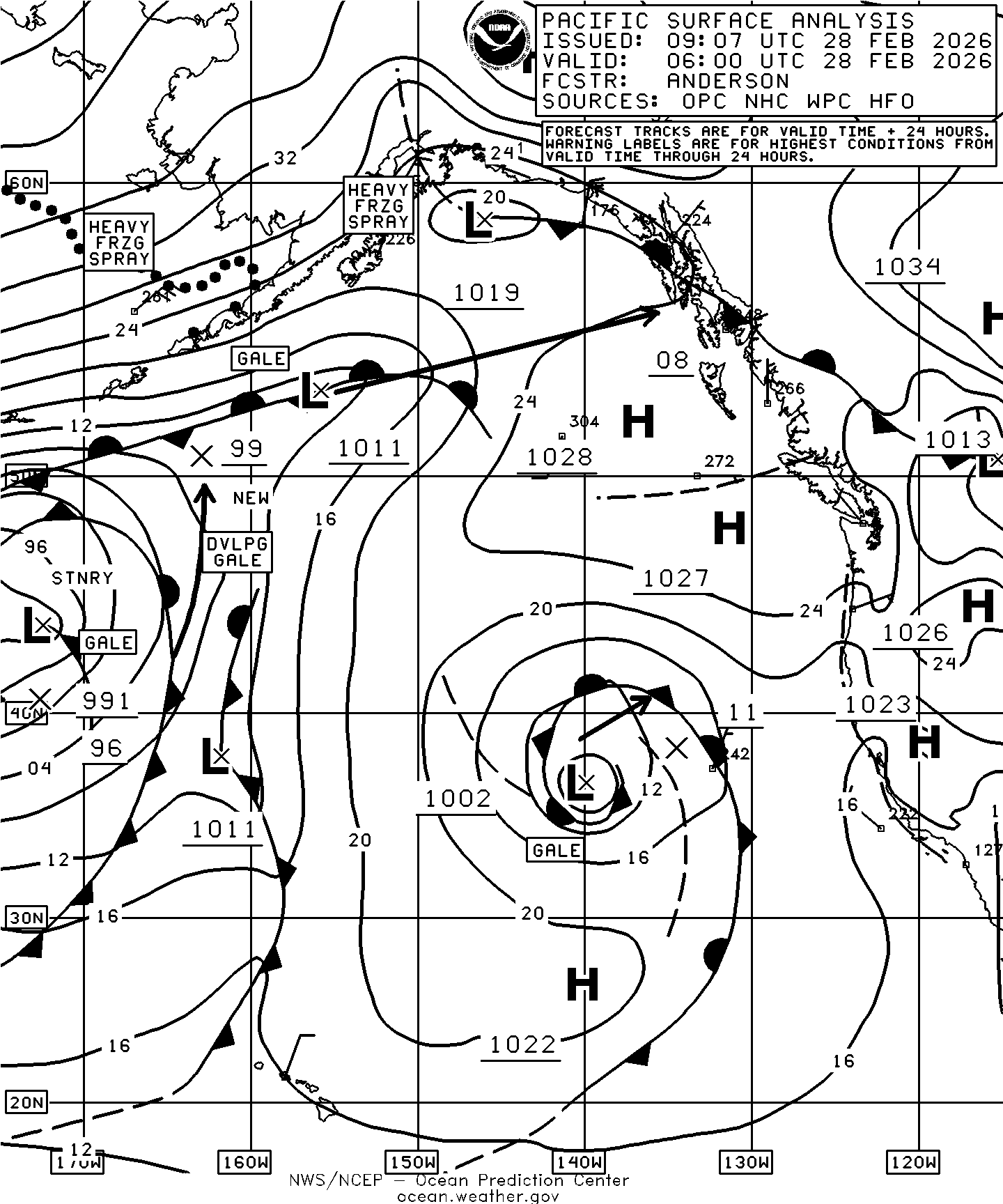
GEOS Local Image of Pacific Northwest
Edit Hide

Middleton,Island/Anchorage,AK

NOTICE: Some pages have affiliate links to Amazon. As an Amazon Associate, I earn from qualifying purchases. Please read website Cookie, Privacy, and Disclamers by clicking HERE. To contact me click HERE. For my YouTube page click HERE