Marine Weather and Tide Forecast for Willapa, WA
![]() | Sunrise 7:36 AM Sunset 7:13 PM Moonrise 1:40 AM Moonset 9:28 AM |
Marine Forecasts
NOTE: Zones were updated 3/20/2025. If your report is out of date, please click Edit
PZZ110 Grays Harbor Bar- 225 Am Pdt Tue Mar 10 2026
.small craft advisory in effect through this afternoon - .
combined seas 8 to 10 ft. Bar conditions moderate to rough at times. Maximum ebb currents will occur around 945 am Tuesday, 10 pm Tuesday, and 1045 am Wednesday.
PZZ100 225 Am Pdt Tue Mar 10 2026
Synopsis for the northern and central washington coastal and inland waters - Onshore flow has eased but seas still running over 10 ft through today and Wednesday. A strong pacific frontal system will impact the region on Wednesday with potential for gales over the waters. A frontal system will stall over the area Thursday and Friday with winds turning northerly over the weekend.
7 Day Forecast for Marine Location Near Willapa, WA

NEW! Add second zone forecast
| Raymond Click for Map Tue -- 02:39 AM PDT Moonrise Tue -- 06:06 AM PDT 9.41 feet High Tide Tue -- 07:37 AM PDT Sunrise Tue -- 10:29 AM PDT Moonset Tue -- 01:05 PM PDT 1.70 feet Low Tide Tue -- 07:14 PM PDT Sunset Tue -- 07:50 PM PDT 6.69 feet High Tide Tide / Current data from XTide NOT FOR NAVIGATION |   |
Raymond, Willapa River, Willapa Bay, Washington, Tide feet
| 12 am |
| 4.2 |
| 1 am |
| 4.6 |
| 2 am |
| 5.6 |
| 3 am |
| 6.9 |
| 4 am |
| 8.1 |
| 5 am |
| 9 |
| 6 am |
| 9.4 |
| 7 am |
| 9.1 |
| 8 am |
| 8.1 |
| 9 am |
| 6.5 |
| 10 am |
| 4.8 |
| 11 am |
| 3.3 |
| 12 pm |
| 2.2 |
| 1 pm |
| 1.7 |
| 2 pm |
| 2 |
| 3 pm |
| 2.8 |
| 4 pm |
| 3.9 |
| 5 pm |
| 5 |
| 6 pm |
| 5.9 |
| 7 pm |
| 6.5 |
| 8 pm |
| 6.7 |
| 9 pm |
| 6.3 |
| 10 pm |
| 5.7 |
| 11 pm |
| 5.1 |
| South Bend Click for Map Flood direction 90 true Ebb direction 270 true Tue -- 12:23 AM PDT 0.00 knots Slack Tue -- 02:39 AM PDT Moonrise Tue -- 02:56 AM PDT 0.83 knots Max Flood Tue -- 06:20 AM PDT -0.00 knots Slack Tue -- 07:37 AM PDT Sunrise Tue -- 09:37 AM PDT -1.24 knots Max Ebb Tue -- 10:29 AM PDT Moonset Tue -- 01:51 PM PDT 0.00 knots Slack Tue -- 04:15 PM PDT 0.57 knots Max Flood Tue -- 07:14 PM PDT Sunset Tue -- 07:55 PM PDT -0.00 knots Slack Tue -- 10:01 PM PDT -0.53 knots Max Ebb Tide / Current data from XTide NOT FOR NAVIGATION |   |
South Bend, Willapa River, Washington Current, knots
| 12 am |
| -0.2 |
| 1 am |
| 0.3 |
| 2 am |
| 0.7 |
| 3 am |
| 0.8 |
| 4 am |
| 0.7 |
| 5 am |
| 0.4 |
| 6 am |
| 0.1 |
| 7 am |
| -0.3 |
| 8 am |
| -0.9 |
| 9 am |
| -1.2 |
| 10 am |
| -1.2 |
| 11 am |
| -1.1 |
| 12 pm |
| -0.8 |
| 1 pm |
| -0.4 |
| 2 pm |
| 0.1 |
| 3 pm |
| 0.4 |
| 4 pm |
| 0.6 |
| 5 pm |
| 0.5 |
| 6 pm |
| 0.5 |
| 7 pm |
| 0.3 |
| 8 pm |
| -0 |
| 9 pm |
| -0.4 |
| 10 pm |
| -0.5 |
| 11 pm |
| -0.5 |
Area Discussion for Portland, OR
Hide  HelpNOTE: mouseover dotted underlined text for definition
FXUS66 KPQR 101805 AFDPQR
Area Forecast Discussion National Weather Service Portland OR 1105 AM PDT Tue Mar 10 2026
SYNOPSIS
Showery conditions with lowering snow levels. A variety of snow related hazards in effect for the Coast Range and the Cascades for today. 15% chance of low elevation accumulating snow in the Portland-Vancouver Metro with increasing chances as you move north. Atmospheric River potential is strengthening on Wednesday through Friday.
Potentially impactful rainfall and snow in the south Washington Cascades, though confidence remains moderate at this time.
SHORT TERM
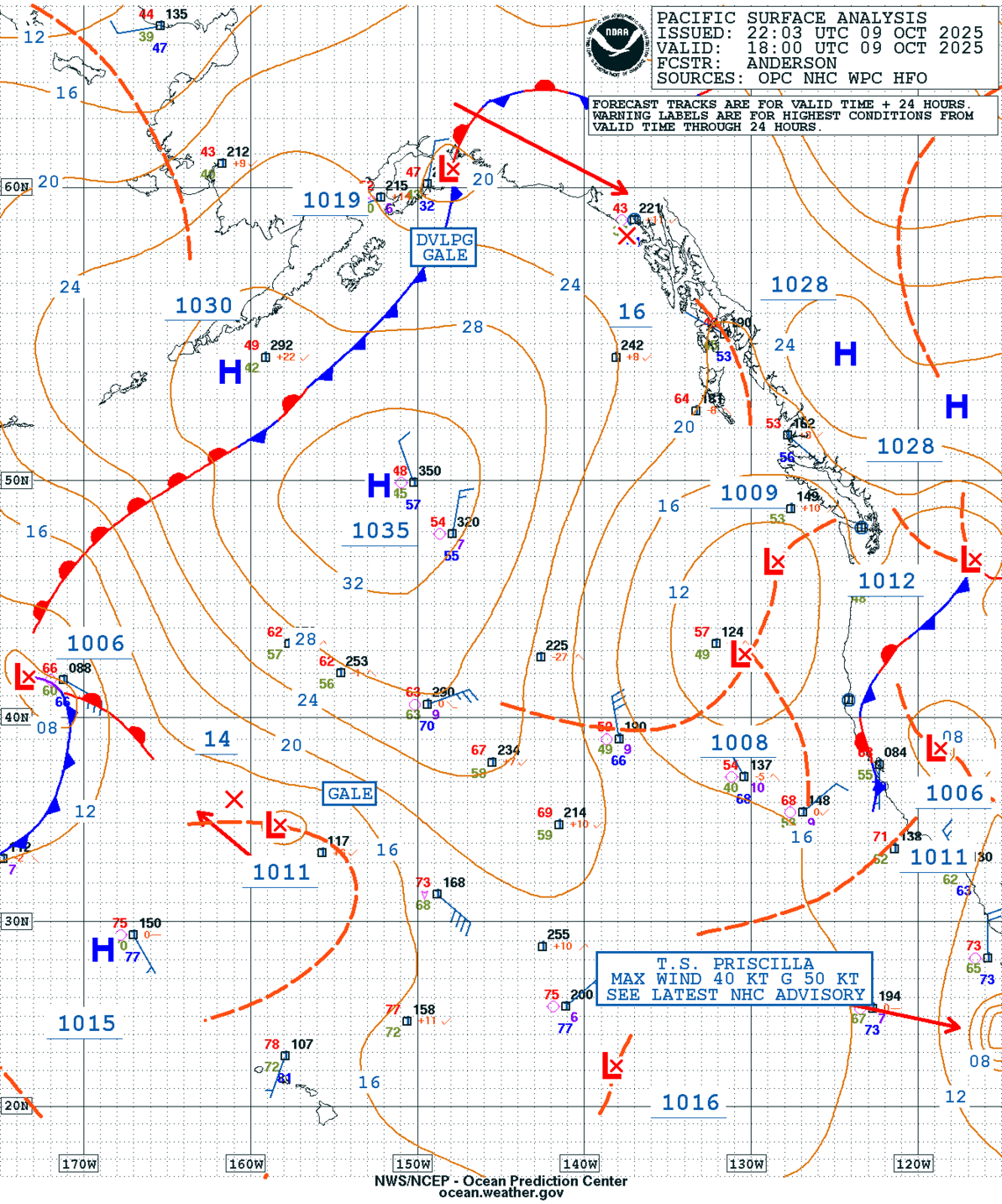
Now through Wednesday Night...The next 48 hours will be quite dynamic. Kicking things off with today. We are seeing the cold wrapped low pressure system in the Gulf of Alaska spinning just off of the Alaska Panhandle. The rotation around this low is pushing a cold front over the region.
Overnight lows have essentially dropped nearly all locations into the 30s, with freezing levels around 800 ft as of this writing. With the cold air filtering in, snow levels have dropped, and will continue to do so over the next few hours. In conjunction with the cold airmass, showers are being produced over the forecast area, and are being orographically influenced by the Cascades. Heaviest precipitation at this point is occurring from Santiam Pass northward. Will see snowfall within the Cascades consistent with an additional 6-10 inches over the next 24-36 hours. Along the peaks and volcanos, snowfall accumulation will be higher.
Snow levels have also dropped low enough to impact the north Oregon and south Washington Coast Range. We could still see around 2-4 inches of snow, but area webcams show little to no snow at this point. Higher resolution simulated reflectivity shows another surge of precipitation later this morning so if the temperatures remain cool enough, then snow chances linger.
The last areas of concern are the interior lowlands. There remains around a 50-70% chance of accumulating snow in the Cowlitz Valley and lower I-5 corridor, and around a 15% chance of snow in the Greater Portland/Vancover-Metro below 500 ft.
Within the West Hills and above 500 ft, those chances rise to around 30% for accumulating snow. Because conditions have been warm for several days, snow will struggle to stick and accumulate.
As this system exits tonight, the low in the Gulf intensifies and high pressure builds in the eastern Pacific. The combination of these two synoptic features will promote strong warm air advection and the presence of a weak to moderate Atmospheric River (AR). The initiation of this AR starts on tonight into Wednesday. There will be enhanced moisture with this incoming system, but snow levels will remain low enough Washington that snow ratios maintain a value that would produce heavy snow in the south Washington Cascades. The Winter Storm Warning remains in effect and in fact, some of the precipitation amounts have increased with the newest forecast package. Therefore, above 3000 ft, around 10-20 inches of snow is expected with up to 20 inches along the peaks and volcanos. 24-hr snowfall totals ending at 5 PM Wednesday shows the 10th to 90th percentile spread at 13 inches to 19 inches above 3000 ft. The risk is significantly lower for the north Oregon Cascades where the 90th percentile shows around 10 inches in 24-hrs below 5500 ft.
While much needed snow may seem like the big headline on Wednesday, hydrological concerns are rising with each new model run. 850 mb temperatures will rise above freezing Wednesday morning and thus, aside from the Cascades, precipitation will fall as rain. 24-hr rainfall totals ending Wednesday night maintain a wide spread with the 10th percentile in Portland around 0.5 inch to the 90th percentile of 2 inches. The coast Range sees significantly higher rainfall totals with the north Oregon Coast Range having a 10% chance of 1.6 inches and a 10% chance of 4.25 inches in that same time frame. How much rain we receive will greatly depend on where the AR sets up. Based on ensembles, the GEFS (global ensembles) is taking more of a northerly path, while there is more consistency between the Canadian and the ENS (European ensembles). Therefore, there is a stronger argument to trend towards higher QPF amounts on Wednesday. If we see the rainfall totals expressed by the 90th percentile, flooding will be a concern on coastal and Coast Range tributary rivers. Confidence remains too low at this time to express explicit concern for which areas have the highest probability of flooding. We will also have to take into account any snow that falls tonight as it would melt simultaneously as the rain and therefore increase the overall water content.
This is a very rapidly changing system and we sit right on the border of being within a direct hit, or sitting on the south side and not seeing as much rain. We will continue to monitor for any potential impacts. -27
LONG TERM
Thursday through Monday...In the short term discussion we introduced the Atmospheric River (AR) and some of it's impact potential for Wednesday. However, that is not the end of the story. A great place to start is to look at Climatology and our "Extreme Forecast Index". This tool allows us to see how the current set up deviates from what is considered climatologically normal. For Thursday, the anomaly is quite strong for the Integrated water vapor transport and QPF. This is our first sign that we could be looking at a high impact scenario. As we then look at some of the synoptic features, there are a few that really stand out. Within the jet stream we sit just south of the main jet streak which, at 500 mb, is nearly 122 kt (that's very strong). This feature can be associated with significant lift and more active weather. We also see a band of warm air streaming in which has a much higher capacity for moisture than a colder airmass. These features remain nearly stationary through Saturday morning; meaning we will see nearly 72 hours of continuous rain.
Probabilistically, there again is a spread, but even the mean (the most likely solution) shows highly impactful rainfall totals. The dry solution (10th percentile) brings around 2.7 inches to Tillamook 3.5 inches to the north Oregon Coast Range, 2.15 inches to Portland, and 3 inches to the north Oregon Cascades. The wet solution (the 90th percentile) on the other hand produces 7.4 inches in Tillamook, over 8 inches in the north Oregon Coast Range, 5.15 inches in Portland and over 8.5 inches within the Cascades. The 90th percentile solution describes a scenario where essentially we get caught right in the bullseye of the AR where the dry scenario insinuates that the AR moved to the north.
With these types of rain amounts, concern for hydrological impacts rises further. Confidence remains low though as again, it will come down to exactly where this system sets up. However, we do have high confidence that somewhere will see those higher end amounts...it just comes down to where. Another factor to consider is that we would most likely not see any river rises until Friday or Saturday due to the water having to move through the smaller watersheds. At this point, the coastal and Coast Range rivers have the highest probability (around 30%) of reaching at least action stage, but there is still ample room for conditions to shift. With this in mind though, prepare for a very wet later half of the week.
Rain eases as we transition into Saturday night and Sunday as a weak area of high pressure forms, and troughing occurs inland over Idaho. This ridging will allow for a break in precipitation, but, if there is enough cold air that filters into the Columbia Basin, we could see some gustier winds. Not to rain on any parades for Monday, but yet another AR approaches the region Sunday night into Monday. At this time the bulk of the rain appears to move to the north and most long-range models agree on that pattern shift. However, we have seen just how fast conditions change and it easily could move southward. If this AR does move south, we could be looking at potentially another impactful rain even. -27
AVIATION
Largely VFR conditions continue ahead of rain showers expected to spread onshore through 21-22z Tue. Brief restrictions to cigs/vis may occur at area terminals, but the timing of these impacts is low confidence due to the scattered nature of showers. Rain showers will transition to a steadier rain by 00z Wed or later, supporting mixed VFR/MVFR conditions which will trend to MVFR across the region (50-70% chance) by 06-12z Wed as cigs lower. The exception to this may be for inland terminals south of US-20 including KEUG/KCVO where lighter rainfall rates and higher ceilings will instead favor persistent low-end VFR conditions. Southerly to southwesterly winds at 5-10 kt will continue inland through the period, with southerly gusts to 20 kt along the central Willamette Valley developing overnight after 09z Wed. Along the coast, gusts will increase above 20 kt after 12-15z Wed as the next stronger cold front approaches.
KPDX AND APPROACHES...VFR flying conditions favored to continue as additional rain showers arrive while southerly winds increase to near 10 kt by 20-22z Tue. Brief vis/cigs restrictions are possible within rain showers, but timing of these impacts is low confidence through this early afternoon.
After 00z Wed, showers will transition to steadier rain, with cigs trending down to MVFR through this evening. -36
MARINE
The marine environment will be quickly evolving over the next 72 hours. Seas and winds are being driven by a low pressure system in the Gulf of Alaska off of the Alaska Panhandle. There is a persistent northwesterly swell with combined seas around 10-13 ft at 13 seconds. Small Craft Advisory remains in effect, but there will be periods of hazardous steep seas. Through the day winds will begin to slowly increase as winds become southerly. The pressure gradient will begin to tighten late tonight into Wednesday. As this occurs there will be a trend towards much higher wind speeds and more widespread hazardous seas.
On Wednesday winds continue to show Gale Force speeds but are generally concentrated on the central and northern waters as of right now. Given that the direction is not truly due south, the south-central waters will be less impacted. However, where gales are not present, hazardous seas will be. Recent models suggest that the chance for gales may be slightly delayed, however, there remains at least a 70% chance for gale force winds as early as late Wednesday morning. Because there remains some level of uncertainty, have issued a gale watch for the Columbia River Bar. A fresh southerly swell will combine with the southerly wind wave and we will see seas build to 14-17 ft by Wednesday night and early Thursday morning. A hazardous Seas Watch has been issued for PZZ253/273.
The pattern remains active late this week and into this weekend, but confidence in the occurrence of hazardous conditions is low at this time. Will note that a strengthening atmospheric river is forecast for Wednesday through at least Friday with strong winds aloft. Some of these winds could mix down to the surface and see isolated high wind gusts. -27
PQR WATCHES/WARNINGS/ADVISORIES
OR...Winter Weather Advisory until 5 PM PDT Wednesday for ORZ126- 127.
WA...Winter Weather Advisory until 5 PM PDT this afternoon for WAZ211.
Winter Storm Warning from 5 PM this afternoon to 5 PM PDT Wednesday for WAZ211.
PZ...Small Craft Advisory until 5 PM PDT Wednesday for PZZ210.
Gale Watch from Wednesday afternoon through late Wednesday night for PZZ210.
Small Craft Advisory until 8 AM PDT Wednesday for PZZ251>253- 271>273.
Gale Watch from Wednesday morning through late Wednesday night for PZZ251-252-271-272.
Hazardous Seas Watch from Wednesday morning through late Wednesday night for PZZ253-273.
Area Forecast Discussion National Weather Service Portland OR 1105 AM PDT Tue Mar 10 2026
SYNOPSIS
Showery conditions with lowering snow levels. A variety of snow related hazards in effect for the Coast Range and the Cascades for today. 15% chance of low elevation accumulating snow in the Portland-Vancouver Metro with increasing chances as you move north. Atmospheric River potential is strengthening on Wednesday through Friday.
Potentially impactful rainfall and snow in the south Washington Cascades, though confidence remains moderate at this time.
SHORT TERM
Now through Wednesday Night...The next 48 hours will be quite dynamic. Kicking things off with today. We are seeing the cold wrapped low pressure system in the Gulf of Alaska spinning just off of the Alaska Panhandle. The rotation around this low is pushing a cold front over the region.
Overnight lows have essentially dropped nearly all locations into the 30s, with freezing levels around 800 ft as of this writing. With the cold air filtering in, snow levels have dropped, and will continue to do so over the next few hours. In conjunction with the cold airmass, showers are being produced over the forecast area, and are being orographically influenced by the Cascades. Heaviest precipitation at this point is occurring from Santiam Pass northward. Will see snowfall within the Cascades consistent with an additional 6-10 inches over the next 24-36 hours. Along the peaks and volcanos, snowfall accumulation will be higher.
Snow levels have also dropped low enough to impact the north Oregon and south Washington Coast Range. We could still see around 2-4 inches of snow, but area webcams show little to no snow at this point. Higher resolution simulated reflectivity shows another surge of precipitation later this morning so if the temperatures remain cool enough, then snow chances linger.
The last areas of concern are the interior lowlands. There remains around a 50-70% chance of accumulating snow in the Cowlitz Valley and lower I-5 corridor, and around a 15% chance of snow in the Greater Portland/Vancover-Metro below 500 ft.
Within the West Hills and above 500 ft, those chances rise to around 30% for accumulating snow. Because conditions have been warm for several days, snow will struggle to stick and accumulate.
As this system exits tonight, the low in the Gulf intensifies and high pressure builds in the eastern Pacific. The combination of these two synoptic features will promote strong warm air advection and the presence of a weak to moderate Atmospheric River (AR). The initiation of this AR starts on tonight into Wednesday. There will be enhanced moisture with this incoming system, but snow levels will remain low enough Washington that snow ratios maintain a value that would produce heavy snow in the south Washington Cascades. The Winter Storm Warning remains in effect and in fact, some of the precipitation amounts have increased with the newest forecast package. Therefore, above 3000 ft, around 10-20 inches of snow is expected with up to 20 inches along the peaks and volcanos. 24-hr snowfall totals ending at 5 PM Wednesday shows the 10th to 90th percentile spread at 13 inches to 19 inches above 3000 ft. The risk is significantly lower for the north Oregon Cascades where the 90th percentile shows around 10 inches in 24-hrs below 5500 ft.
While much needed snow may seem like the big headline on Wednesday, hydrological concerns are rising with each new model run. 850 mb temperatures will rise above freezing Wednesday morning and thus, aside from the Cascades, precipitation will fall as rain. 24-hr rainfall totals ending Wednesday night maintain a wide spread with the 10th percentile in Portland around 0.5 inch to the 90th percentile of 2 inches. The coast Range sees significantly higher rainfall totals with the north Oregon Coast Range having a 10% chance of 1.6 inches and a 10% chance of 4.25 inches in that same time frame. How much rain we receive will greatly depend on where the AR sets up. Based on ensembles, the GEFS (global ensembles) is taking more of a northerly path, while there is more consistency between the Canadian and the ENS (European ensembles). Therefore, there is a stronger argument to trend towards higher QPF amounts on Wednesday. If we see the rainfall totals expressed by the 90th percentile, flooding will be a concern on coastal and Coast Range tributary rivers. Confidence remains too low at this time to express explicit concern for which areas have the highest probability of flooding. We will also have to take into account any snow that falls tonight as it would melt simultaneously as the rain and therefore increase the overall water content.
This is a very rapidly changing system and we sit right on the border of being within a direct hit, or sitting on the south side and not seeing as much rain. We will continue to monitor for any potential impacts. -27
LONG TERM
Thursday through Monday...In the short term discussion we introduced the Atmospheric River (AR) and some of it's impact potential for Wednesday. However, that is not the end of the story. A great place to start is to look at Climatology and our "Extreme Forecast Index". This tool allows us to see how the current set up deviates from what is considered climatologically normal. For Thursday, the anomaly is quite strong for the Integrated water vapor transport and QPF. This is our first sign that we could be looking at a high impact scenario. As we then look at some of the synoptic features, there are a few that really stand out. Within the jet stream we sit just south of the main jet streak which, at 500 mb, is nearly 122 kt (that's very strong). This feature can be associated with significant lift and more active weather. We also see a band of warm air streaming in which has a much higher capacity for moisture than a colder airmass. These features remain nearly stationary through Saturday morning; meaning we will see nearly 72 hours of continuous rain.
Probabilistically, there again is a spread, but even the mean (the most likely solution) shows highly impactful rainfall totals. The dry solution (10th percentile) brings around 2.7 inches to Tillamook 3.5 inches to the north Oregon Coast Range, 2.15 inches to Portland, and 3 inches to the north Oregon Cascades. The wet solution (the 90th percentile) on the other hand produces 7.4 inches in Tillamook, over 8 inches in the north Oregon Coast Range, 5.15 inches in Portland and over 8.5 inches within the Cascades. The 90th percentile solution describes a scenario where essentially we get caught right in the bullseye of the AR where the dry scenario insinuates that the AR moved to the north.
With these types of rain amounts, concern for hydrological impacts rises further. Confidence remains low though as again, it will come down to exactly where this system sets up. However, we do have high confidence that somewhere will see those higher end amounts...it just comes down to where. Another factor to consider is that we would most likely not see any river rises until Friday or Saturday due to the water having to move through the smaller watersheds. At this point, the coastal and Coast Range rivers have the highest probability (around 30%) of reaching at least action stage, but there is still ample room for conditions to shift. With this in mind though, prepare for a very wet later half of the week.
Rain eases as we transition into Saturday night and Sunday as a weak area of high pressure forms, and troughing occurs inland over Idaho. This ridging will allow for a break in precipitation, but, if there is enough cold air that filters into the Columbia Basin, we could see some gustier winds. Not to rain on any parades for Monday, but yet another AR approaches the region Sunday night into Monday. At this time the bulk of the rain appears to move to the north and most long-range models agree on that pattern shift. However, we have seen just how fast conditions change and it easily could move southward. If this AR does move south, we could be looking at potentially another impactful rain even. -27
AVIATION
Largely VFR conditions continue ahead of rain showers expected to spread onshore through 21-22z Tue. Brief restrictions to cigs/vis may occur at area terminals, but the timing of these impacts is low confidence due to the scattered nature of showers. Rain showers will transition to a steadier rain by 00z Wed or later, supporting mixed VFR/MVFR conditions which will trend to MVFR across the region (50-70% chance) by 06-12z Wed as cigs lower. The exception to this may be for inland terminals south of US-20 including KEUG/KCVO where lighter rainfall rates and higher ceilings will instead favor persistent low-end VFR conditions. Southerly to southwesterly winds at 5-10 kt will continue inland through the period, with southerly gusts to 20 kt along the central Willamette Valley developing overnight after 09z Wed. Along the coast, gusts will increase above 20 kt after 12-15z Wed as the next stronger cold front approaches.
KPDX AND APPROACHES...VFR flying conditions favored to continue as additional rain showers arrive while southerly winds increase to near 10 kt by 20-22z Tue. Brief vis/cigs restrictions are possible within rain showers, but timing of these impacts is low confidence through this early afternoon.
After 00z Wed, showers will transition to steadier rain, with cigs trending down to MVFR through this evening. -36
MARINE
The marine environment will be quickly evolving over the next 72 hours. Seas and winds are being driven by a low pressure system in the Gulf of Alaska off of the Alaska Panhandle. There is a persistent northwesterly swell with combined seas around 10-13 ft at 13 seconds. Small Craft Advisory remains in effect, but there will be periods of hazardous steep seas. Through the day winds will begin to slowly increase as winds become southerly. The pressure gradient will begin to tighten late tonight into Wednesday. As this occurs there will be a trend towards much higher wind speeds and more widespread hazardous seas.
On Wednesday winds continue to show Gale Force speeds but are generally concentrated on the central and northern waters as of right now. Given that the direction is not truly due south, the south-central waters will be less impacted. However, where gales are not present, hazardous seas will be. Recent models suggest that the chance for gales may be slightly delayed, however, there remains at least a 70% chance for gale force winds as early as late Wednesday morning. Because there remains some level of uncertainty, have issued a gale watch for the Columbia River Bar. A fresh southerly swell will combine with the southerly wind wave and we will see seas build to 14-17 ft by Wednesday night and early Thursday morning. A hazardous Seas Watch has been issued for PZZ253/273.
The pattern remains active late this week and into this weekend, but confidence in the occurrence of hazardous conditions is low at this time. Will note that a strengthening atmospheric river is forecast for Wednesday through at least Friday with strong winds aloft. Some of these winds could mix down to the surface and see isolated high wind gusts. -27
PQR WATCHES/WARNINGS/ADVISORIES
OR...Winter Weather Advisory until 5 PM PDT Wednesday for ORZ126- 127.
WA...Winter Weather Advisory until 5 PM PDT this afternoon for WAZ211.
Winter Storm Warning from 5 PM this afternoon to 5 PM PDT Wednesday for WAZ211.
PZ...Small Craft Advisory until 5 PM PDT Wednesday for PZZ210.
Gale Watch from Wednesday afternoon through late Wednesday night for PZZ210.
Small Craft Advisory until 8 AM PDT Wednesday for PZZ251>253- 271>273.
Gale Watch from Wednesday morning through late Wednesday night for PZZ251-252-271-272.
Hazardous Seas Watch from Wednesday morning through late Wednesday night for PZZ253-273.
| Stations | Dist | Age | Wind | Air | Water | Waves | inHg | DewPt |
| TOKW1 - 9440910 - Toke Point, WA | 16 mi | 56 min | SSE 14G | 38°F | 50°F | 30.19 | ||
| WPTW1 - 9441102 - Westport, WA | 28 mi | 80 min | 30.17 | |||||
| 46211 - Grays Harbor, WA (036) | 33 mi | 60 min | 50°F | 10 ft | ||||
| ASTO3 - 9439040 - Astoria, OR | 33 mi | 56 min | SSW 6G | 42°F | ||||
| 46243 - Clatsop Spit, OR - 162 | 40 mi | 56 min | 41°F | 47°F | 10 ft |
Wind History for Toke Point, WA
toggle option: (graph/table)
Airport Reports
Link to 1 hour of 5 minute data for KHQM
Terminal Aerodrome Forecast (TAF) for KHQM
Wind History Graph: HQM
(wind in knots)GEOS Local Image of Pacific Northwest
Edit Hide
Langley,Hill/Gray,Harbor,WA
NOTICE: Some pages have affiliate links to Amazon. As an Amazon Associate, I earn from qualifying purchases. Please read website Cookie, Privacy, and Disclamers by clicking HERE. To contact me click HERE. For my YouTube page click HERE


