Marine Weather and Tide Forecast for Anchor Point, AK
 | Sunrise 7:39 AM Sunset 8:05 PM Moonrise 5:18 PM Moonset 10:40 PM |
Marine Forecasts
NOTE: Zones updated 4/16/2026. Some zones changed. Use Edit if needed.
PKZ741 Kachemak Bay- 345 Pm Akdt Sun Sep 20 2026
Tonight - W wind 15 kt. Seas 4 ft.
Mon - SW wind 10 kt. Seas 2 ft. Rain showers.
Mon night - Variable wind less than 10 kt. Seas 2 ft.
Tue and Tue night - Variable wind less than 10 kt. Seas 2 ft.
Wed - Variable wind less than 10 kt. Seas 2 ft.
Thu through Fri - SE wind 25 kt. Seas 3 ft.
PKZ700
No data
No data
7 Day Forecast for Marine Location Near Anchor Point, AK

NEW! Add second zone forecast
| Anchor Point Click for Map Sun -- 04:32 AM AKDT 4.61 feet Low Tide Sun -- 07:48 AM AKDT Sunrise Sun -- 12:00 PM AKDT 12.69 feet High Tide Sun -- 04:56 PM AKDT 8.66 feet Low Tide Sun -- 07:16 PM AKDT Moonrise Sun -- 08:12 PM AKDT Sunset Sun -- 11:22 PM AKDT 13.78 feet High Tide Tide / Current data from XTide NOT FOR NAVIGATION |
Anchor Point, Cook Inlet, Alaska, Tide feet
| 12 am |
| 11.5 |
| 1 am |
| 9.6 |
| 2 am |
| 7.5 |
| 3 am |
| 5.7 |
| 4 am |
| 4.7 |
| 5 am |
| 4.7 |
| 6 am |
| 5.3 |
| 7 am |
| 6.4 |
| 8 am |
| 7.9 |
| 9 am |
| 9.6 |
| 10 am |
| 11.2 |
| 11 am |
| 12.3 |
| 12 pm |
| 12.7 |
| 1 pm |
| 12.3 |
| 2 pm |
| 11.2 |
| 3 pm |
| 9.9 |
| 4 pm |
| 9 |
| 5 pm |
| 8.7 |
| 6 pm |
| 9 |
| 7 pm |
| 9.7 |
| 8 pm |
| 10.6 |
| 9 pm |
| 11.9 |
| 10 pm |
| 13.1 |
| 11 pm |
| 13.7 |
| Anchor Point Click for Map Flood direction 358 true Ebb direction 182 true Sun -- 12:47 AM AKDT -0.00 knots Slack Sun -- 04:19 AM AKDT -0.98 knots Max Ebb Sun -- 06:48 AM AKDT 0.00 knots Slack Sun -- 07:48 AM AKDT Sunrise Sun -- 11:17 AM AKDT 2.27 knots Max Flood Sun -- 02:35 PM AKDT -0.00 knots Slack Sun -- 05:38 PM AKDT -1.43 knots Max Ebb Sun -- 07:17 PM AKDT Moonrise Sun -- 07:56 PM AKDT 0.00 knots Slack Sun -- 08:12 PM AKDT Sunset Sun -- 11:17 PM AKDT 1.40 knots Max Flood Tide / Current data from XTide NOT FOR NAVIGATION |
Anchor Point, west of (depth 12 ft), Cook Inlet, Alaska Current, knots
| 12 am |
| 0.5 |
| 1 am |
| -0.1 |
| 2 am |
| -0.7 |
| 3 am |
| -0.9 |
| 4 am |
| -1 |
| 5 am |
| -0.9 |
| 6 am |
| -0.6 |
| 7 am |
| 0.2 |
| 8 am |
| 1 |
| 9 am |
| 1.5 |
| 10 am |
| 2 |
| 11 am |
| 2.2 |
| 12 pm |
| 2.1 |
| 1 pm |
| 1.5 |
| 2 pm |
| 0.5 |
| 3 pm |
| -0.3 |
| 4 pm |
| -0.9 |
| 5 pm |
| -1.3 |
| 6 pm |
| -1.4 |
| 7 pm |
| -0.8 |
| 8 pm |
| 0.1 |
| 9 pm |
| 0.7 |
| 10 pm |
| 1.2 |
| 11 pm |
| 1.4 |
FXAK68 PAFC 210040 AFDAFC
Southcentral and Southwest Alaska Forecast Discussion National Weather Service Anchorage AK 440 PM AKDT Sun Sep 20 2026
.SHORT TERM FORECAST SOUTHCENTRAL ALASKA (Days 1 through 3: Today through Wednesday night)...
A large, occluded low pressure system continues to spin across the northern Gulf this afternoon. Radar returns show the low's outer rain bands pivoting across the immediate Gulf coast, with a few waves of showers making it as far as west as the Anchorage Bowl. Generally speaking, longwave troughing aloft dominates all of Alaska and the North Pacific. A strengthening, digging shortwave trough embedded in the longwave is moving southeastward over the Alaska Peninsula this afternoon and is backing the occluded low northwestward towards Chenega before it drives inland and weakens later tonight. Until then, expect periods of moderate rain showers with gusty winds along the immediate Gulf coast.
Expect increased rain showers for inland areas of Southcentral as the low moves inland, favoring the Copper River Basin through Monday morning, though more intermittent showers are still on track for the Anchorage Bowl. Gusty southerly gap winds are possible by Monday afternoon for the Copper River Valley and Palmer areas as this remnant low moves northward. Low impact gap winds from Kamishak Gap moving across the Barren Islands in the wake of this system will lead to some areas of small craft winds with higher gusts for this area through Tuesday morning.
The robust shortwave trough moving over the Alaska Peninsula will help spawn an area of low pressure southeast of Kodiak Island late Monday morning to early Monday afternoon. At the same time, models show a more compact low moving northward from the North Pacific and across the southern Gulf early Monday afternoon and begins to deepen as it aligns with upper level divergence and positive vorticity advection from the longwave trough. Models are in good agreement that this low tracks into the eastern Gulf with small craft to gale force winds and becomes quasi-stationary and in the process of occluding by Tuesday afternoon. Southcentral then remains relatively quiet before a much more potent system moves closer to the western Gulf late Wednesday afternoon, though model agreement is below average for this period. Due to this being a potentially impactful system for some, please stay tuned to the forecast as we draw closer to this time frame.
-AM/TM
Southcentral and Southwest Alaska Forecast Discussion National Weather Service Anchorage AK 440 PM AKDT Sun Sep 20 2026
.SHORT TERM FORECAST SOUTHCENTRAL ALASKA (Days 1 through 3: Today through Wednesday night)...
A large, occluded low pressure system continues to spin across the northern Gulf this afternoon. Radar returns show the low's outer rain bands pivoting across the immediate Gulf coast, with a few waves of showers making it as far as west as the Anchorage Bowl. Generally speaking, longwave troughing aloft dominates all of Alaska and the North Pacific. A strengthening, digging shortwave trough embedded in the longwave is moving southeastward over the Alaska Peninsula this afternoon and is backing the occluded low northwestward towards Chenega before it drives inland and weakens later tonight. Until then, expect periods of moderate rain showers with gusty winds along the immediate Gulf coast.
Expect increased rain showers for inland areas of Southcentral as the low moves inland, favoring the Copper River Basin through Monday morning, though more intermittent showers are still on track for the Anchorage Bowl. Gusty southerly gap winds are possible by Monday afternoon for the Copper River Valley and Palmer areas as this remnant low moves northward. Low impact gap winds from Kamishak Gap moving across the Barren Islands in the wake of this system will lead to some areas of small craft winds with higher gusts for this area through Tuesday morning.
The robust shortwave trough moving over the Alaska Peninsula will help spawn an area of low pressure southeast of Kodiak Island late Monday morning to early Monday afternoon. At the same time, models show a more compact low moving northward from the North Pacific and across the southern Gulf early Monday afternoon and begins to deepen as it aligns with upper level divergence and positive vorticity advection from the longwave trough. Models are in good agreement that this low tracks into the eastern Gulf with small craft to gale force winds and becomes quasi-stationary and in the process of occluding by Tuesday afternoon. Southcentral then remains relatively quiet before a much more potent system moves closer to the western Gulf late Wednesday afternoon, though model agreement is below average for this period. Due to this being a potentially impactful system for some, please stay tuned to the forecast as we draw closer to this time frame.
-AM/TM
.SHORT TERM FORECAST SOUTHWEST ALASKA AND BERING SEA/ALEUTIANS (Days 1 through 3: This afternoon through Wednesday afternoon)...
Key Messages:
- Gusty northwesterly winds and persistent showers for the Aleutians and Alaska Peninsula through early this week.
- Trending colder for Southwest Alaska, though overnight lows will ultimately depend on cloud cover. Still, many locations could see overnight and morning temperatures near or below freezing tonight through midweek, with greatest chances (70% or greater)
for interior Southwest.
- Looking ahead: Winds to gale force and light to moderate rain for the Aleutians from late Monday into Wednesday as a strengthening low pressure system enters from the west and interacts with the remnants of Typhoon Dujuan. Confidence remains fairly low.
Discussion:
Few changes to the forecast for the next 24 hours. The upper level pattern continues to feature a broad, longwave trough extending from the Bering, across much of Mainland Alaska, and into the Gulf. Weak shortwaves moving south along the backside of the ridge will bring periods of gustier winds and more frequent/heavier showers as they transit across the Bering Sea, Alaska Peninsula, and Southwest Alaska through Monday.
For Southwest Alaska, the biggest story continues to be increased chances for temperatures near or below freezing. As the airmass that will bring this colder air will also be quite dry, any snow will almost certainly be limited to higher elevation mountains, where orographic lift will have a better chance of squeezing out some precipitation. Still, with overnight lows forecast to dip close to or even below freezing at lower elevations tonight through midweek, now is a good time to start bringing things indoors in preparation for winter.
Finally, from late Monday into midweek, attention shifts to several features moving into the Bering Sea from the west. First will be a low curving up from just south of the Kamchatka Peninsula. Since yesterday, this low has trended further south in its track. As such, gale force winds look to remain mostly out of the coastal waters of the Aleutians. The second feature will be the remnants of Typhoon Dujuan, which will likely interact in some form with the Bering low around Tuesday night. What this interaction looks like, and the resulting storm evolution(s), will be the hinge upon which the midweek forecast rests.
Unfortunately, there's still quite a bit of uncertainty with the extent to which these features will interact, and how much of Dujuan's energy will enter the Aleutians versus remaining further afield in the North Pacific. As such, many scenarios remain at play. What we can say is that the storm resulting from this interaction has trended weaker and further south. While a further north track and stronger storm remains possible and could lead to significant impacts, the emergence of model solutions featuring a further south track suggests that impacts could also be less concerning than initially forecast yesterday. Either way, overall confidence remains fairly low, so stay tuned to the forecast for updates.
-KC/JH
.LONG TERM FORECAST (Days 4 through 7: Thursday through Sunday)...
Key messages:
- A very strong low pressure system will develop over the Bering Sea between Wednesday and Friday.
- Strong winds, large waves and heavy rainfall are likely near this storm system across much of the Bering Sea, Pribilof Islands, and portions of Southwest towards the latter half of this week.
- A threat for coastal flooding will exist along the Southwest coast sometime between Wednesday evening and Saturday. The concern for significant coastal flooding has lessened (25% to 35% chance) due to the storm likely remaining farther south.
Discussion:
The interaction of a low in the Bering Sea and the remnants of typhoon Dujuan is the forecast challenge for the second half of this week through next weekend. What makes this system so complex is that the ex-Dujuan system will basically split its energy on Wednesday with a good potion of its moisture and heat being entrained into the Bering Sea low which will rapidly strengthen it. The other part of its energy will not get entrained and will track eastward, south of the Aleutian Islands. The amount of moisture that is absorbed into the Bering Sea low will determine how strong each low becomes. Attempting to resolve this is giving fits to all of the models whether they be deterministic, ensemble, or AI models. All are struggling with the track, timing, and strength of this intensifying Bering Sea low which is to be expected.
However, even in all this chaos, there are some things that look more likely than others. First, models are all backing off a the expected strength of this low. Yesterday they ranged from a minimum central pressure of 935 mb to 945 mb. Today that range is closer to 960 to 970 mb. That is a significant difference in strength and a strong, but not extreme system. Second, the track is trending farther to the south on just about all model types.
This is very important for the threat of coastal flooding in the Kuskokwim Delta as the farther south the low tracks, the less likely coastal flooding will be. There remains a chance the low center track as far north as Nunivak Island on Thursday or Friday, which would be the worst scenario for Kuskokwim Delta storm surge. However, the more likely scenario is that the low center remains farther to the south and west which will keep winds from a southeasterly to northeasterly direction which would only put a few areas (such as Kwigillingok) at risk and only during southeasterly winds along the front.
The Aleutian Islands from Attu through Dutch Harbor will likely see the strongest winds in this storm. It is still too early to really nail down where and when the strongest winds will occur.
However, with the anticipated weaker central pressure of the low, maximum gusts are expected to be in the 70 to 80 mph range which is lower than it looked like yesterday when the low looked like it would be stronger.
Even with these trends, there is still a chance the entire former typhoon gets absorbed into the Bering Sea low and intensifies stronger than it looks today. This will still be a large and strong low with rough weather even at a weaker strength, so this system bears watching closely for anyone with interests in Southwest Alaska or the Bering Sea region.
As for Southcentral and the Gulf of Alaska region: the low that track south of the Aleutians will make its way to the Gulf of Alaska region Thursday into Friday. As with the the Bering Sea low, this one has a high degree of uncertainty due to it still being uncertain how much of this storm's energy get entrained into the Bering Sea low. At this time, it does appear likely that a fairly strong front will move into the Gulf of Alaska by Thursday and bring rain and wind to the Gulf region. What happens next with this low, and whether it intensifies in the Gulf or weakens there, will be dependent on what happens with the Bering Sea low.
AVIATION
PANC...The next round of rain and MVFR ceilings arrives this evening and overnight as a low in the Gulf moves into the Prince William Sound. Showers with this round will persist through Monday morning. Ceilings are on track to lower to IFR throughout the morning hours as visibility ticks down to MVFR with any heavier showers. Expect mostly light and variable winds through Monday morning. Rain showers will continue through Monday afternoon with MVFR visibility and IFR ceilings.
Key Messages:
- Gusty northwesterly winds and persistent showers for the Aleutians and Alaska Peninsula through early this week.
- Trending colder for Southwest Alaska, though overnight lows will ultimately depend on cloud cover. Still, many locations could see overnight and morning temperatures near or below freezing tonight through midweek, with greatest chances (70% or greater)
for interior Southwest.
- Looking ahead: Winds to gale force and light to moderate rain for the Aleutians from late Monday into Wednesday as a strengthening low pressure system enters from the west and interacts with the remnants of Typhoon Dujuan. Confidence remains fairly low.
Discussion:
Few changes to the forecast for the next 24 hours. The upper level pattern continues to feature a broad, longwave trough extending from the Bering, across much of Mainland Alaska, and into the Gulf. Weak shortwaves moving south along the backside of the ridge will bring periods of gustier winds and more frequent/heavier showers as they transit across the Bering Sea, Alaska Peninsula, and Southwest Alaska through Monday.
For Southwest Alaska, the biggest story continues to be increased chances for temperatures near or below freezing. As the airmass that will bring this colder air will also be quite dry, any snow will almost certainly be limited to higher elevation mountains, where orographic lift will have a better chance of squeezing out some precipitation. Still, with overnight lows forecast to dip close to or even below freezing at lower elevations tonight through midweek, now is a good time to start bringing things indoors in preparation for winter.
Finally, from late Monday into midweek, attention shifts to several features moving into the Bering Sea from the west. First will be a low curving up from just south of the Kamchatka Peninsula. Since yesterday, this low has trended further south in its track. As such, gale force winds look to remain mostly out of the coastal waters of the Aleutians. The second feature will be the remnants of Typhoon Dujuan, which will likely interact in some form with the Bering low around Tuesday night. What this interaction looks like, and the resulting storm evolution(s), will be the hinge upon which the midweek forecast rests.
Unfortunately, there's still quite a bit of uncertainty with the extent to which these features will interact, and how much of Dujuan's energy will enter the Aleutians versus remaining further afield in the North Pacific. As such, many scenarios remain at play. What we can say is that the storm resulting from this interaction has trended weaker and further south. While a further north track and stronger storm remains possible and could lead to significant impacts, the emergence of model solutions featuring a further south track suggests that impacts could also be less concerning than initially forecast yesterday. Either way, overall confidence remains fairly low, so stay tuned to the forecast for updates.
-KC/JH
.LONG TERM FORECAST (Days 4 through 7: Thursday through Sunday)...
Key messages:
- A very strong low pressure system will develop over the Bering Sea between Wednesday and Friday.
- Strong winds, large waves and heavy rainfall are likely near this storm system across much of the Bering Sea, Pribilof Islands, and portions of Southwest towards the latter half of this week.
- A threat for coastal flooding will exist along the Southwest coast sometime between Wednesday evening and Saturday. The concern for significant coastal flooding has lessened (25% to 35% chance) due to the storm likely remaining farther south.
Discussion:
The interaction of a low in the Bering Sea and the remnants of typhoon Dujuan is the forecast challenge for the second half of this week through next weekend. What makes this system so complex is that the ex-Dujuan system will basically split its energy on Wednesday with a good potion of its moisture and heat being entrained into the Bering Sea low which will rapidly strengthen it. The other part of its energy will not get entrained and will track eastward, south of the Aleutian Islands. The amount of moisture that is absorbed into the Bering Sea low will determine how strong each low becomes. Attempting to resolve this is giving fits to all of the models whether they be deterministic, ensemble, or AI models. All are struggling with the track, timing, and strength of this intensifying Bering Sea low which is to be expected.
However, even in all this chaos, there are some things that look more likely than others. First, models are all backing off a the expected strength of this low. Yesterday they ranged from a minimum central pressure of 935 mb to 945 mb. Today that range is closer to 960 to 970 mb. That is a significant difference in strength and a strong, but not extreme system. Second, the track is trending farther to the south on just about all model types.
This is very important for the threat of coastal flooding in the Kuskokwim Delta as the farther south the low tracks, the less likely coastal flooding will be. There remains a chance the low center track as far north as Nunivak Island on Thursday or Friday, which would be the worst scenario for Kuskokwim Delta storm surge. However, the more likely scenario is that the low center remains farther to the south and west which will keep winds from a southeasterly to northeasterly direction which would only put a few areas (such as Kwigillingok) at risk and only during southeasterly winds along the front.
The Aleutian Islands from Attu through Dutch Harbor will likely see the strongest winds in this storm. It is still too early to really nail down where and when the strongest winds will occur.
However, with the anticipated weaker central pressure of the low, maximum gusts are expected to be in the 70 to 80 mph range which is lower than it looked like yesterday when the low looked like it would be stronger.
Even with these trends, there is still a chance the entire former typhoon gets absorbed into the Bering Sea low and intensifies stronger than it looks today. This will still be a large and strong low with rough weather even at a weaker strength, so this system bears watching closely for anyone with interests in Southwest Alaska or the Bering Sea region.
As for Southcentral and the Gulf of Alaska region: the low that track south of the Aleutians will make its way to the Gulf of Alaska region Thursday into Friday. As with the the Bering Sea low, this one has a high degree of uncertainty due to it still being uncertain how much of this storm's energy get entrained into the Bering Sea low. At this time, it does appear likely that a fairly strong front will move into the Gulf of Alaska by Thursday and bring rain and wind to the Gulf region. What happens next with this low, and whether it intensifies in the Gulf or weakens there, will be dependent on what happens with the Bering Sea low.
AVIATION
PANC...The next round of rain and MVFR ceilings arrives this evening and overnight as a low in the Gulf moves into the Prince William Sound. Showers with this round will persist through Monday morning. Ceilings are on track to lower to IFR throughout the morning hours as visibility ticks down to MVFR with any heavier showers. Expect mostly light and variable winds through Monday morning. Rain showers will continue through Monday afternoon with MVFR visibility and IFR ceilings.
| Stations | Dist | Age | Wind | Air | Water | Waves | inHg | DewPt |
| APXA2 | 1 mi | 62 min | N 6 | 51°F | 29.15 | 48°F | ||
| 46108 - Central Cook Inlet - 175 | 12 mi | 47 min | 50°F | 2 ft | ||||
| OVIA2 - 9455500 - Seldovia, AK | 24 mi | 47 min | 49°F | 29.17 | ||||
| HMSA2 | 25 mi | 15 min | SSE 1.9G | 52°F | 29.15 | 43°F | ||
| FILA2 - Flat Island Light, AK | 31 mi | 27 min | WNW 14G | 50°F | 29.17 | 46°F |
Wind History for Nikiski, AK
toggle option: (graph/table)
Link to 5 hour of 5 minute data for PAHO
Terminal Aerodrome Forecast (TAF) for PAHO
Wind History Graph: AHO
(wind in knots)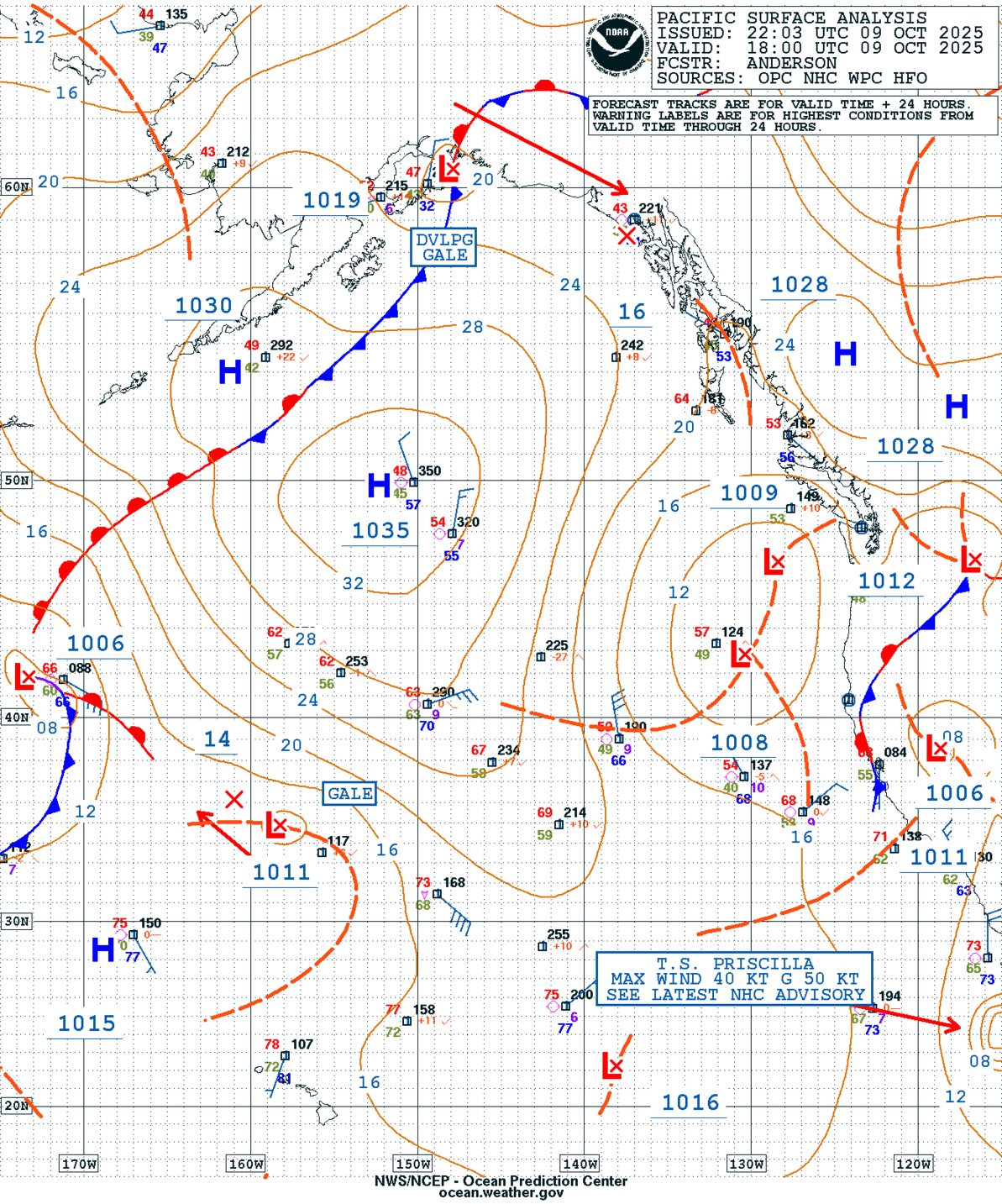
GEOS Local Image of Alaska
Edit Hide

Anchorage/Kenai,AK

NOTICE: Some pages have affiliate links to Amazon. As an Amazon Associate, I earn from qualifying purchases. Please read website Cookie, Privacy, and Disclamers by clicking HERE. To contact me click HERE. For my YouTube page click HERE
X