Marine Weather and Tide Forecast for Barre, VT
![]() | Sunrise 7:17 AM Sunset 6:49 PM Moonrise 12:00 AM Moonset 9:05 AM |
Marine Forecasts
NOTE: Zones were updated 3/20/2025. If your report is out of date, please click Edit
7 Day Forecast for Marine Location Near Barre, VT

NEW! Add second zone forecast
Area Discussion for Burlington, VT
Hide  HelpNOTE: mouseover dotted underlined text for definition
FXUS61 KBTV 082329 AFDBTV
Area Forecast Discussion National Weather Service Burlington VT 729 PM EDT Sun Mar 8 2026
WHAT HAS CHANGED
As of 725 PM EDT Sunday...
No significant changes. Localized flooding due to ice jams have occurred today on the Mad River, Ausable River, and Missisquoi River. Activity is likely to slow with the setting of the sun and cooling temperatures.
KEY MESSAGES
As of 250 PM EDT Sunday...
1. River flows will slowly subside overnight, but additional rises will occur through mid week due to snowmelt and rainfall.
River ice breakup is likely, with ice jams and associated flooding possible.
2. Gusty and seasonably strong wind gusts will continue early this evening and again tomorrow, especially in western and northern portions of northern New York. Unseasonable warmth will persist through the next few days.
3. After a stretch of spring-like weather, more widespread precipitation is expected to arrive for the middle of next week.
DISCUSSION
As of 250 PM EDT Sunday...
KEY MESSAGE 1: As anticipated, the recent mild temperatures have lead to significant snowmelt. Areawide, many areas with substantial snowpack lost 4 to 8 inches of depth, locally 9 to 12 inches across the higher terrain. This snowmelt in addition to what little rainfall we received over the past 24 to 36 hours resulted in rises along area waterways. This in turn lead to some river ice movement, notably on the Mad River in Vermont and the Ausable River in NY.
While the NY river ice was relatively transient and flushed downriver with occasional brief jams and minor flooding, the Mad River jam remains in place as of this writing. Known impacts are minor, and with flows to slowly subside, this jam could well settle in place until we see additional melt in the next few days.
Our bigger concern continues to be for the middle of this week. This weekend's snowmelt should slow or even stop tonight as temperatures drop back close to or below freezing, allowing rivers to recede a bit. However, this will be short lived as we'll warm well into the 50s and even 60s Monday, Tuesday, and Wednesday. Dewpoints won't be overly high, but we will have periods of gusty winds. Overnight temperatures are expected to mainly stay near or above freezing, so there won't be a whole lot of recovery between peak snowmelt times.
This will all make for fairly optimal snowmelt conditions that should continue to eat at the snowpack. Lower elevations have already lost most if not all of their snow. Higher elevations will also see substantial loss of the pack, though how much exactly is still hard to determine at this point. The latest NOHRSC analysis estimates there was a general 1 to 1.5 inches to perhaps as much as 2 inches of SWE melted out since yesterday. Meanwhile, the GEFS/NAEFS continue to indicate another 1 to 3 inches of additional melt through Wednesday. Precipitation does return by Wednesday morning and continues through Thursday. Total liquid precipitation amounts of 0.50 to 1.50 inches are currently anticipated. While there's still some uncertainty on precipitation type, it's expected much of this will be rain. With all of this in mind, especially that we've already had some river ice movement today, we remain confident that additional ice movement and potential ice jams/flooding will occur over the next few days. This is especially true on more central/southern waterways that have a better chance of remaining consistently above freezing. Of course, river ice break up and resultant ice jams and any flooding are fairly unpredictable, especially this far out in time. With that in mind, we urge anyone with interests along area waterways to monitor future forecasts closely. As far as open water flooding, we don't anticipate any widespread issues at this time. However, some ensemble guidance shows rivers such as the Mad River, Ausable, Otter Creek, and Winooski potentially exceeding minor flood stage. And at the least, waterways will be running high, even smaller tributaries and streams.
We would also like to urge those who live, work, or travel along area rivers to take proper precautions and stay alert for rapidly changing conditions. Ice jams can occur very quickly, and water can rise several feet in just a few minutes. Water levels can also surge suddenly when a jam releases. We urge everyone to stay well away from the water's edge and never walk on any ice.
KEY MESSAGE 2: Through Tuesday, unseasonably warm conditions, with temperatures about 20 to 25 degrees above normal, will continue along with periods of breezy conditions, especially this evening and again tomorrow during much of the day. This afternoon we are seeing intermittently breezy post-frontal winds with westerly flow. Winds are trending more southwesterly towards evening. A mid-level trough quickly swinging through will not bring precipitation but will promote enhanced mixing of a belt of stronger winds. Evening timing will limit the extent of mixing, but 30 to 35 MPH gusts will be common across northern New York, except the Champlain Valley, from about 5 to 10 PM today, as well as near and just east of Green Mountain spine.
More widespread and persistent breezy conditions will redevelop during the day tomorrow. The ECMWF extreme forecast index highlights the northern St. Lawrence Valley, but with a low value indicative of non-significant type of stronger winds. These winds will develop in response to the pressure gradient between a seasonably deep low pressure area over eastern Ontario, well north of the US, and a ridge of high pressure over our region. Probability of wind gusts exceeding 40 MPH in Massena is currently greater than 70%. Normally for a Wind Advisory type of wind event we'd need to see a low track closer to the region, but would not ignore the forecast soundings showing channeled flow/shallow inversion height with top of the mixed layer winds near 50 knots midday tomorrow. As such, while forecast peak wind gusts were bumped up a bit in the northern St.
Lawrence Valley, will note potential for localized gusts closer to 50 MPH exists, which is near the 90th percentile in the REFS guidance, especially between about noon and 4 PM. Breezy, but not as strong, gusts will be possible elsewhere in northern New York and Vermont given diurnal mixing and the aforementioned pressure gradient. Ridgetops across our mountains will be quite windy throughout the day with gusts of 50 to 55 MPH, and even possibly approaching 70 MPH at the highest summits, will be common given the progged 900 to 825 millibar winds.
Signals for unusual warmth, which could result in localized record highs on Monday and Tuesday, continue. On Monday the warmth looks pronounced across our area, and then primarily in central and southern portions of Vermont and the Adirondacks on Tuesday as slightly cooler air filters in from the north. As far as actual temperature forecasts, will note there may be too much of a bias correction with the cold conditions we've had over the last couple of months. Some of the statistical guidance shows more widespread low to mid 60 high temperatures than the current forecast indicates for tomorrow; coupled with some of the dynamical models, greatest confidence in these warmest conditions are in the southern portions of the Champlain Valley and Upper Valley in Vermont.
KEY MESSAGE 3: A low pressure system centered over the Great Lakes will track northeastward towards the middle of next week, bringing widespread precipitation chances to the region Wednesday into Thursday. There continues to be uncertainty in regards to precipitation type at this point, primarily due to temperatures and low track. Strong southerly flow on Wednesday should help allow temperatures to warm into the 50s and even 60s in some locations during the day, with warm overnight lows expected.The current forecast supports mostly rain, with a transition to snow as a sharp cold front pusses across the region during the day Thursday. The only exception looks to be portions of the northern St. Lawrence Valley, where colder air at the surface looks more favorable for a period of freezing rain on Wednesday morning before warming up. At this point is is still too tricky to tell for sure, as small differences in thermal profiles and surface temperature can play a large role in the precipitation type, but is something to monitor over the next few days as we get closer. After the cold front Thursday, temperatures for the end of the week look to trend closer to seasonal normals for early March, with highs in the mid 30s to low 40s and some additional chances for showers.
AVIATION /00Z MONDAY THROUGH FRIDAY/
Through 00Z Tuesday...VFR conditions will prevail over the next 24 hours. Winds are the main concern for the next day. Skies are mostly clear over Vermont, and there's a layer of clouds around 8000-10000 ft agl across northern New York. South to southwest winds of 5-13 knots, gusting around 20-24 knots at KMSS is ongoing. There's likely to be little change over the next 12 hours, while winds aloft remain out of the southwest to west at 35-45 knots. Activity will decrease some between 10z-14z, but surface winds and winds at 2000 ft agl will increase again during the day. This will be most notable at KMSS, where southwest winds will increase to 20 knots sustained with gusts up to 35 knots.
Outlook...
Monday Night: VFR. NO SIG WX.
Tuesday: Mainly VFR, with local MVFR possible. NO SIG WX.
Tuesday Night: Mainly MVFR, with local VFR possible. Chance RA, Likely FZRA.
Wednesday: Mainly MVFR, with local IFR possible. Definite RA, Definite FZRA.
Wednesday Night: Mainly MVFR, with areas IFR possible. Definite RA.
Thursday: Mainly VFR, with areas MVFR possible. Chance RA, Chance SN.
Thursday Night: VFR. Slight chance SN.
Friday: VFR. Chance SN, Likely RA.
CLIMATE
Record High Minimum temperatures today are possible at Plattsburgh (PBG) and Burlington (BTV). Below are the records that may be broken or tied.
BTV: 41/2012 PBG: 39/1973
Record High Maximum temperatures are possible on Tuesday (Monday records are less likely to be broken). As of now, this is favored at Montpelier (MPV) and the current record is:
MPV: 60/2016
EQUIPMENT
The KBTV ASOS has suffered a communications failure. The issue has been diagnosed, but there is currently no estimated time of return to service. The affected communications line is not serviced by the NWS. Terminal Aerodrome Forecasts will continue, but regular observations may not be available.
NOAA Weather Radio station WXM-44, transmitting from Mt.
Ascutney, Vermont, on frequency 162.475 MHz is non- operational at this time. NWS technicians have diagnosed the problem, but repairs will likely not be able to occur for quite some time due to circumstances beyond our control. Therefore, the time of return to service is currently unknown. The following NOAA Weather Radio transmitters may be able to provide service during this outage: WWG 50 from Burke Mtn, VT at 162.425 MHz and WNG 546 from Hanover, NH at 162.525 MHz.
The Colchester Reef meteorological station is out of service.
This site is not serviced by the NWS and there isn't an estimated return to service at present. Please contact us if you observe winds significantly deviating from the recreational forecast.
BTV WATCHES/WARNINGS/ADVISORIES
VT...None.
NY...None.
Area Forecast Discussion National Weather Service Burlington VT 729 PM EDT Sun Mar 8 2026
WHAT HAS CHANGED
As of 725 PM EDT Sunday...
No significant changes. Localized flooding due to ice jams have occurred today on the Mad River, Ausable River, and Missisquoi River. Activity is likely to slow with the setting of the sun and cooling temperatures.
KEY MESSAGES
As of 250 PM EDT Sunday...
1. River flows will slowly subside overnight, but additional rises will occur through mid week due to snowmelt and rainfall.
River ice breakup is likely, with ice jams and associated flooding possible.
2. Gusty and seasonably strong wind gusts will continue early this evening and again tomorrow, especially in western and northern portions of northern New York. Unseasonable warmth will persist through the next few days.
3. After a stretch of spring-like weather, more widespread precipitation is expected to arrive for the middle of next week.
DISCUSSION
As of 250 PM EDT Sunday...
KEY MESSAGE 1: As anticipated, the recent mild temperatures have lead to significant snowmelt. Areawide, many areas with substantial snowpack lost 4 to 8 inches of depth, locally 9 to 12 inches across the higher terrain. This snowmelt in addition to what little rainfall we received over the past 24 to 36 hours resulted in rises along area waterways. This in turn lead to some river ice movement, notably on the Mad River in Vermont and the Ausable River in NY.
While the NY river ice was relatively transient and flushed downriver with occasional brief jams and minor flooding, the Mad River jam remains in place as of this writing. Known impacts are minor, and with flows to slowly subside, this jam could well settle in place until we see additional melt in the next few days.
Our bigger concern continues to be for the middle of this week. This weekend's snowmelt should slow or even stop tonight as temperatures drop back close to or below freezing, allowing rivers to recede a bit. However, this will be short lived as we'll warm well into the 50s and even 60s Monday, Tuesday, and Wednesday. Dewpoints won't be overly high, but we will have periods of gusty winds. Overnight temperatures are expected to mainly stay near or above freezing, so there won't be a whole lot of recovery between peak snowmelt times.
This will all make for fairly optimal snowmelt conditions that should continue to eat at the snowpack. Lower elevations have already lost most if not all of their snow. Higher elevations will also see substantial loss of the pack, though how much exactly is still hard to determine at this point. The latest NOHRSC analysis estimates there was a general 1 to 1.5 inches to perhaps as much as 2 inches of SWE melted out since yesterday. Meanwhile, the GEFS/NAEFS continue to indicate another 1 to 3 inches of additional melt through Wednesday. Precipitation does return by Wednesday morning and continues through Thursday. Total liquid precipitation amounts of 0.50 to 1.50 inches are currently anticipated. While there's still some uncertainty on precipitation type, it's expected much of this will be rain. With all of this in mind, especially that we've already had some river ice movement today, we remain confident that additional ice movement and potential ice jams/flooding will occur over the next few days. This is especially true on more central/southern waterways that have a better chance of remaining consistently above freezing. Of course, river ice break up and resultant ice jams and any flooding are fairly unpredictable, especially this far out in time. With that in mind, we urge anyone with interests along area waterways to monitor future forecasts closely. As far as open water flooding, we don't anticipate any widespread issues at this time. However, some ensemble guidance shows rivers such as the Mad River, Ausable, Otter Creek, and Winooski potentially exceeding minor flood stage. And at the least, waterways will be running high, even smaller tributaries and streams.
We would also like to urge those who live, work, or travel along area rivers to take proper precautions and stay alert for rapidly changing conditions. Ice jams can occur very quickly, and water can rise several feet in just a few minutes. Water levels can also surge suddenly when a jam releases. We urge everyone to stay well away from the water's edge and never walk on any ice.
KEY MESSAGE 2: Through Tuesday, unseasonably warm conditions, with temperatures about 20 to 25 degrees above normal, will continue along with periods of breezy conditions, especially this evening and again tomorrow during much of the day. This afternoon we are seeing intermittently breezy post-frontal winds with westerly flow. Winds are trending more southwesterly towards evening. A mid-level trough quickly swinging through will not bring precipitation but will promote enhanced mixing of a belt of stronger winds. Evening timing will limit the extent of mixing, but 30 to 35 MPH gusts will be common across northern New York, except the Champlain Valley, from about 5 to 10 PM today, as well as near and just east of Green Mountain spine.
More widespread and persistent breezy conditions will redevelop during the day tomorrow. The ECMWF extreme forecast index highlights the northern St. Lawrence Valley, but with a low value indicative of non-significant type of stronger winds. These winds will develop in response to the pressure gradient between a seasonably deep low pressure area over eastern Ontario, well north of the US, and a ridge of high pressure over our region. Probability of wind gusts exceeding 40 MPH in Massena is currently greater than 70%. Normally for a Wind Advisory type of wind event we'd need to see a low track closer to the region, but would not ignore the forecast soundings showing channeled flow/shallow inversion height with top of the mixed layer winds near 50 knots midday tomorrow. As such, while forecast peak wind gusts were bumped up a bit in the northern St.
Lawrence Valley, will note potential for localized gusts closer to 50 MPH exists, which is near the 90th percentile in the REFS guidance, especially between about noon and 4 PM. Breezy, but not as strong, gusts will be possible elsewhere in northern New York and Vermont given diurnal mixing and the aforementioned pressure gradient. Ridgetops across our mountains will be quite windy throughout the day with gusts of 50 to 55 MPH, and even possibly approaching 70 MPH at the highest summits, will be common given the progged 900 to 825 millibar winds.
Signals for unusual warmth, which could result in localized record highs on Monday and Tuesday, continue. On Monday the warmth looks pronounced across our area, and then primarily in central and southern portions of Vermont and the Adirondacks on Tuesday as slightly cooler air filters in from the north. As far as actual temperature forecasts, will note there may be too much of a bias correction with the cold conditions we've had over the last couple of months. Some of the statistical guidance shows more widespread low to mid 60 high temperatures than the current forecast indicates for tomorrow; coupled with some of the dynamical models, greatest confidence in these warmest conditions are in the southern portions of the Champlain Valley and Upper Valley in Vermont.
KEY MESSAGE 3: A low pressure system centered over the Great Lakes will track northeastward towards the middle of next week, bringing widespread precipitation chances to the region Wednesday into Thursday. There continues to be uncertainty in regards to precipitation type at this point, primarily due to temperatures and low track. Strong southerly flow on Wednesday should help allow temperatures to warm into the 50s and even 60s in some locations during the day, with warm overnight lows expected.The current forecast supports mostly rain, with a transition to snow as a sharp cold front pusses across the region during the day Thursday. The only exception looks to be portions of the northern St. Lawrence Valley, where colder air at the surface looks more favorable for a period of freezing rain on Wednesday morning before warming up. At this point is is still too tricky to tell for sure, as small differences in thermal profiles and surface temperature can play a large role in the precipitation type, but is something to monitor over the next few days as we get closer. After the cold front Thursday, temperatures for the end of the week look to trend closer to seasonal normals for early March, with highs in the mid 30s to low 40s and some additional chances for showers.
AVIATION /00Z MONDAY THROUGH FRIDAY/
Through 00Z Tuesday...VFR conditions will prevail over the next 24 hours. Winds are the main concern for the next day. Skies are mostly clear over Vermont, and there's a layer of clouds around 8000-10000 ft agl across northern New York. South to southwest winds of 5-13 knots, gusting around 20-24 knots at KMSS is ongoing. There's likely to be little change over the next 12 hours, while winds aloft remain out of the southwest to west at 35-45 knots. Activity will decrease some between 10z-14z, but surface winds and winds at 2000 ft agl will increase again during the day. This will be most notable at KMSS, where southwest winds will increase to 20 knots sustained with gusts up to 35 knots.
Outlook...
Monday Night: VFR. NO SIG WX.
Tuesday: Mainly VFR, with local MVFR possible. NO SIG WX.
Tuesday Night: Mainly MVFR, with local VFR possible. Chance RA, Likely FZRA.
Wednesday: Mainly MVFR, with local IFR possible. Definite RA, Definite FZRA.
Wednesday Night: Mainly MVFR, with areas IFR possible. Definite RA.
Thursday: Mainly VFR, with areas MVFR possible. Chance RA, Chance SN.
Thursday Night: VFR. Slight chance SN.
Friday: VFR. Chance SN, Likely RA.
CLIMATE
Record High Minimum temperatures today are possible at Plattsburgh (PBG) and Burlington (BTV). Below are the records that may be broken or tied.
BTV: 41/2012 PBG: 39/1973
Record High Maximum temperatures are possible on Tuesday (Monday records are less likely to be broken). As of now, this is favored at Montpelier (MPV) and the current record is:
MPV: 60/2016
EQUIPMENT
The KBTV ASOS has suffered a communications failure. The issue has been diagnosed, but there is currently no estimated time of return to service. The affected communications line is not serviced by the NWS. Terminal Aerodrome Forecasts will continue, but regular observations may not be available.
NOAA Weather Radio station WXM-44, transmitting from Mt.
Ascutney, Vermont, on frequency 162.475 MHz is non- operational at this time. NWS technicians have diagnosed the problem, but repairs will likely not be able to occur for quite some time due to circumstances beyond our control. Therefore, the time of return to service is currently unknown. The following NOAA Weather Radio transmitters may be able to provide service during this outage: WWG 50 from Burke Mtn, VT at 162.425 MHz and WNG 546 from Hanover, NH at 162.525 MHz.
The Colchester Reef meteorological station is out of service.
This site is not serviced by the NWS and there isn't an estimated return to service at present. Please contact us if you observe winds significantly deviating from the recreational forecast.
BTV WATCHES/WARNINGS/ADVISORIES
VT...None.
NY...None.
Airport Reports
Link to 1 hour of 5 minute data for KMPV
Terminal Aerodrome Forecast (TAF) for KMPV
Wind History Graph: MPV
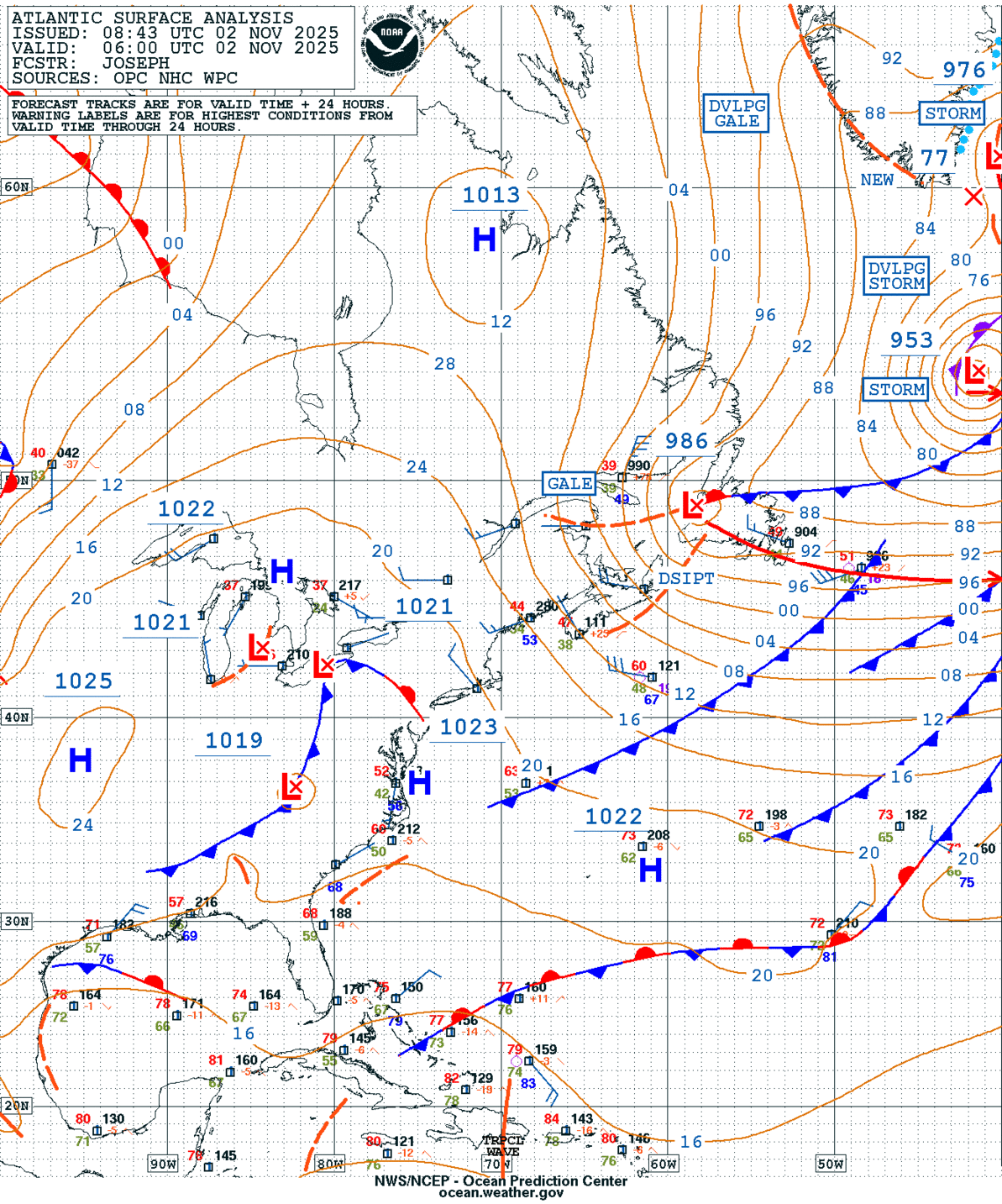
(wind in knots)GEOS Local Image of north east
Edit Hide
Burlington, VT,
NOTICE: Some pages have affiliate links to Amazon. As an Amazon Associate, I earn from qualifying purchases. Please read website Cookie, Privacy, and Disclamers by clicking HERE. To contact me click HERE. For my YouTube page click HERE


